Friday, March 18, 2011

A push-me-pull-you

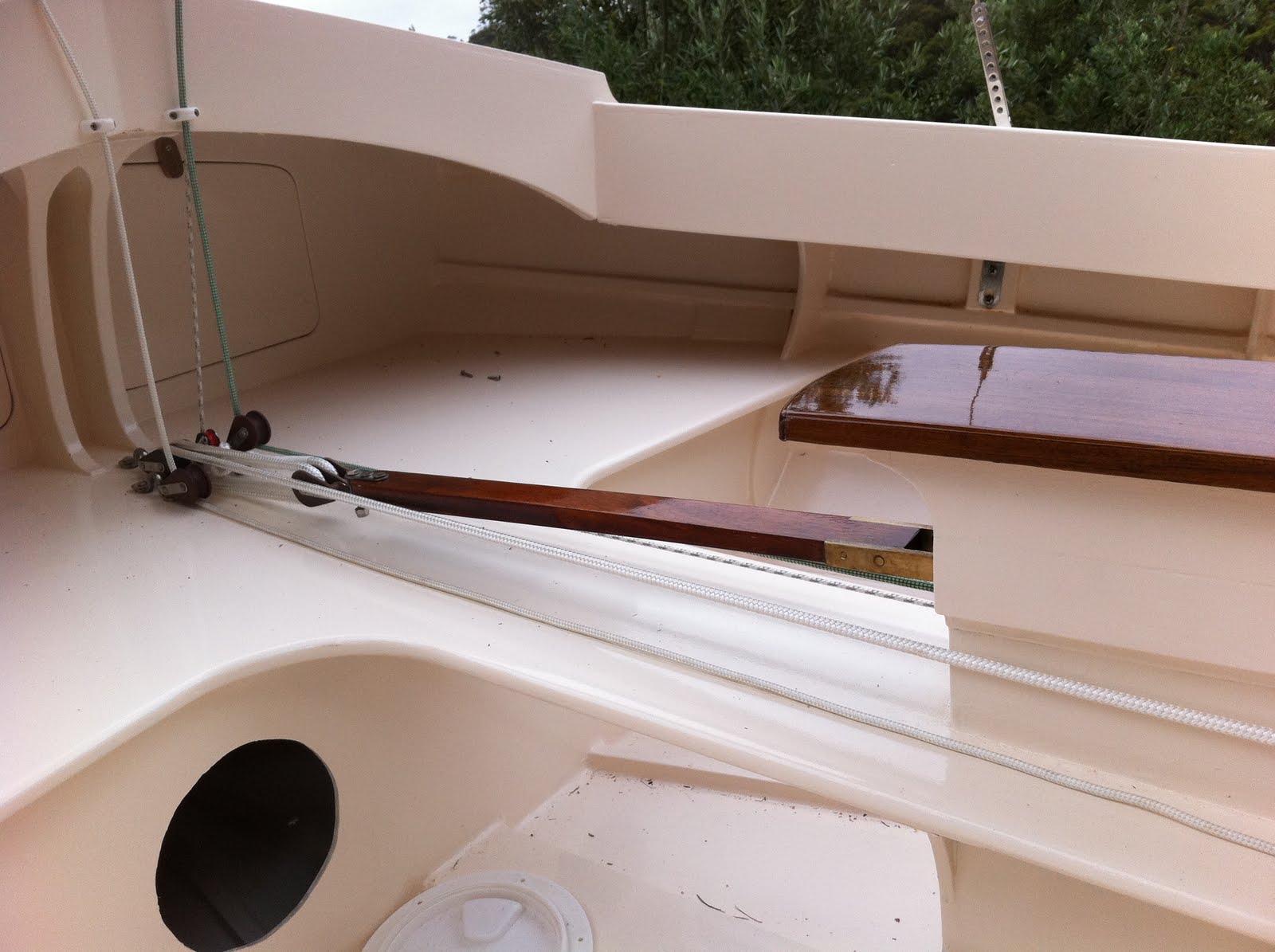
I've read a lot of comments and debate about downhauls for this centreboard design. The connecting arm is quite short and I wanted to solve the potential problems of pushing a stuck board down, or even just holding it down when sailing beyond Mach3, but I wasn't taken with the idea of having cables inside the case. The extension arm should sort these issues, I hope. It has a rod and bush at each end and it slips away into the case when the board is lowered, with just enough sticking out to enable a line to be attached to a cleat, or even a shock cord loop to keep the board down. It is shown in these shots in the board up position. I guess I have to wait to see how well it works in practice, but it is good to use on the trailer! (and is probably another example of me over-designing simple problems into unnecessarily complex solutions)

Tuesday, March 15, 2011

craft shop on a stick...

Sure is a different experience setting up this rig compared to the aluminium and rivets and self-tapping screws on the modern mast of the last boat. Just on this end of the yard we have leather, beads and knots (never a strong point with me even as a cub scout) all sorted into complex shapes and combinations. Every little sub-assembly has a history- a story- and various ways of going about things.
I'm not concerned about being precious or historically correct about this though. This dinghy has some traditional influences, to be sure, but it is still a boat that can take or leave some modern contraptions, and for me it comes down to beauty, ease of use and maintenance. It is very sensuous to have an excuse to cut and bend some leather- and it feels good and sounds fine when in use.
On the other hand, I'm happy to start with modern synthetic braided lines (despite the fact that I find splicing them very frustrating) because they are stable and tough.
One of the very untraditional things I'm up to is to take the peak and throat halyards, the CB tackle, topping lift and furler line right back to the helm and fix them with tufnol cam cleats. It is such luxury to be able to do all these things without leaving one's seat. I've discovered that lifting a gaff sail while seated is a pleasure I hope to have regularly.

Sunday, March 13, 2011

electric pod nearly ready for wiring

The pod has been neglected since I started setting up and varnishing spars, and while it looks quite comfortable hanging under there, the well is full of unconnected wires and unfinished surfaces. My little brain can only cope with so much multi-tasking, so I'm concentrating on set-up, one sail at a time. Centreboard and pod work remain on the periphery of my consciousness.

Monday, March 7, 2011

coastal life and death near Port Fairy


The sparsely populated south western coast of Victoria has patches of spectacular, if un-approachable coast, under-pinned by dark volcanic boulders, much younger sandstone from a time when the seas were much higher, and clean majestic dunes spreading themselves erratically over these other layers where tide and wind allow it.

I've written briefly last year about the Irish heritage in some of these areas and this is most evident in the towns and farms and architecture- and in the scale of these things.

We love to potter along the edges, where sand meets rock, or amazing heaths burst out of crevices, or where vastly different textures stand shoulder to shoulder against their common exposure to very powerful elements.

Sunday, March 6, 2011

the serendipity of diminishing returns


Gone are the days of buckets of epoxy and the saw cutting swathes through acres of ply. Now it takes all morning to find the right spot for a cleat. But having said that, it is also time to multi-task. To-day I sanded and varnished the yard, made and installed some angled blocks for the jib sheet cleats, epoxied one side of the centre-board, fitted the jib halyard cleat and two aft painter cleats, fitted two deck blocks, varnished the mizzen mast and bomkin, and plotted the solution to the old 'how-does-this-design-deal-with-the-problem-of-holding-down-the-centreboard' problem. In short I did my best to move like the old 'road-runner', having had a few days away with Julia at a lovely part of the coast. I love wild coast, and I really loved the company I had...but I do like shed time too.
Incidentally, last time we went to Port Fairy we loved the food at Portofino restaurant. From this trip I would add Lemon Grass Thai restaurant- really lovely, fresh food.

Sunday, February 27, 2011

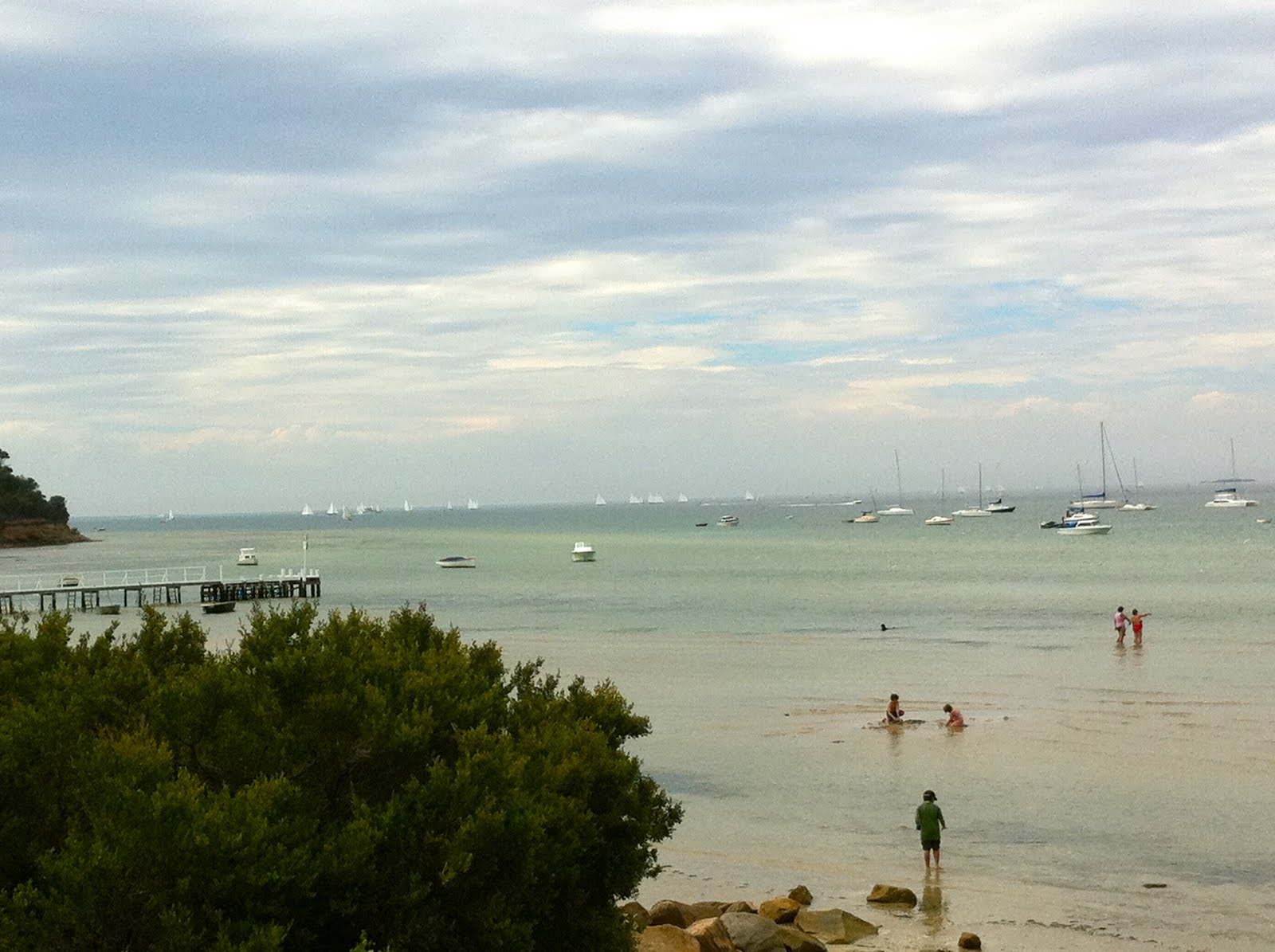
Sail Day with some Wooden Boat Association members, Rye Victoria

Above, Tony's slippery sharpie 'Ursa' skiff viewed from Paul's scaled-up Tammy Norrie yawl
A Scruffy, a sharpie, the club's Oughtred dinghy, a racing 'fireball', a 1952 canoe, and the Tammie Norrie.
The week-end saw us drive the perimeter of Port Phillip, beginning with a drive to Queenscliff, the car ferry over to Sorrento, a picnic at Point Nepean (the old Quarantine Station, and later Army Barracks and Officer Training Facility) and then a lovely afternoon spent on Rye beach with some members of the Wooden Boat Association, and half a dozen of their boats. This was a very relaxing time with gentle breezes, pleasant water and very good company.

Of course I couldn't help pointing the camera at everything that looked like it would float, and some of these will appear on Page Three Boat Pics and this blog over the next little while.
The above pic is a detail of a NZ Kauri Pine clinker dinghy thought to be about 100 years old and restored by Wayne Parr, shipwright at Woodenboatshop Sorrento Victoria. It has a single lug sail and has been nicely restored to an un-glamourised working condition.

Friday, February 18, 2011

new life


Angelique, a Belted Galloway cow, presented the first of the new crop of calves this morning, a little heifer which, when I first saw it, was curled and looking for all the world like a very small black hole in our top paddock. There is nothing like a birth to remind you of the possibility of perfection here on Earth, but it is a grounded view of perfection, reminding us of the heavy cycle of life and death that we often pretend to ignore as sophisticated people- often living on the protein from these creatures without ever giving any thought to their dignity as fellow sentient beings.

You can't live with a herd of cattle without becoming aware of their sensitivity towards each other, their social relationships, their capacity to feel quite complex nuances of emotion, in general quite a few of the things that we regard as especially human. The more we concentrate ourselves in cities, the more abstract these lives become to us and the less we care to know about the grubby details of their lives and deaths- the births and the slaughter.

I walked over to this sweet little thing with the tools in hand to steal it's sex if I found it to be male- because if that was it's gender, the only future he would have would be to live and grow until big enough to be eaten. As it happens, she was not a bull calf, so she has some chance of living into maturity and having calves herself.

Tonight, wondering if the other cows might be ready to calve, we walked up to the little mob with a nagging doubt about the new calf. She was calm and quite self-possessed, but we hadn't seen her suck. Moving quietly amongst them- with the sort of supportive interest shown by all the other cattle (even the steers), I moved them about to see if the calf would take refuge at the milky place under it's mum, but she still hadn't connected with the working bits.

The defining, memorable moment for me came when, at the right time, I gently lifted the front of the calf and put the teat into her mouth. Half a ton of cow stood stock steaming still next to me, seeming to know my intentions and trusting my interference. We three soon leant into each other as the calf eventually got the hang of it and the cow made soft noises. It was all I could do not to make soft noises too.


Monday, February 14, 2011

two steaks on the BBQ


A gob-smackingly gorgeous evening to be out of town. Home in the country feels twice as good as normal on a Monday night. Twenty Degrees C., but a little easterly wind to keep things fresh, just the two of us on yet another Valentine's day. (the steaks weren't as black as they look in the photo) (if anything, Julia's was a little rare) I feel really blessed to be sharing these simple, perfect moments with the person that I attached myself to in my very early 20's.

The boat demands a different kind of focus now. No more mixing epoxy in 80ml batches- it's all about varnish and fittings; finishing sub-assemblies and drilling holes. I've been in this headspace before and I know enough to let it flow at its own pace, and enjoy the process. This sometimes takes a bit of discipline because it is tempting to imagine a few clear days of work to have her on the water. But there is always more in finishing than you can hold in your mind and the end of the process is not worth considering, but the enjoyment of attending to details is...


Friday, February 4, 2011

starting the brightwork

Well, if you have a very little brain, varnishing can seem like a change of pace from painting. So, this is the first coat on the brightwork, even though I haven't finished painting. And for a complete change of pace, I'm making the tiller extension, possibly as avoidance behavior because business is picking up and I feel some slight rise in pressure. The cleats happened because there were plenty of things I should have been doing instead. I sometimes wonder if I'll ever get anything done when I retire, because that pressure to do the right thing won't be there....(this was the sort of mind that sometimes needed the pressure of a deadline to get excited about an assignment when I was studying)

Sometimes it is nice to have an imperative to give energy to a parallel, totally unrelated dreamscape.

Monday, January 31, 2011

in praise of the knife


Making a few cleats began with me using the tools that I've been working with on site, but it felt all clumsy and wrong-handed. Nasty, gritty, vibrating things didn't feel good in making such a humble and simple device, so I resorted much more comfortably to my little planes and then my violin making knives. What a difference! Silence and comfort at the bench.
The knife shown has a long taper and so it could be considered similar to a skew chisel, but with two bevels. The beauty of it is that it slices across a contour, so that instead of cutting down as with a chisel, you cut across, and as the blade gets wider, the cut progresses deeper into the work. Slicing slivers from hardwood is much easier than pairing it or cutting it across the grain. With this simple tool, cutting small radii is a pleasure.
The knife is simply a piece of German tool steel set into a pair of facing grooves in the handle stock before they were glued together. The blade can be removed for honing.

Incidentally, the navigator book is now available on Kindle from Amazon. I'll put a link on the book's blog page sometime...


Monday, January 24, 2011

learning to walk slow

Billy, above, is mainly Julia's dog, but he has become part of the business when it's just him and me at the workshop. I've given him a role in Customer Relations, but he is sometimes a bit too enthusiastic in his work.
Being rescued from some sort of urban situation, his country walks are fairly straight-forward affairs; mainly concerned with avoiding any sort of wildlife and staying as close to our legs as possible. But it is a different story when we're at work in town. Walking is a mission. An artform. He is the first male dog we've had. Our female dogs attended to bladder issues simply and directly, much preferring to sniff actual dogs than their sign-posts.
But Billy has taught me to walk very slowly, not exactly smelling the roses, but something in that vein. His first desire in the morning is to check his p-mails, but he does so in a tedious series of log-ins that stretches the perimeter of his claimed territory. Before I've even logged-in, he is at me for a second round, because things of the second priority cannot be done while re-establishing dominance after a night's rest.
Slow Walking. It has a nice ring to it. Perhaps there are benefits for those of us who are habitually goal-oriented, simply to saunter, and pause at every post.

When sailing on our Waller 540, Billy chooses to occupy the locker under Julia, carefully finding the opposite one as we all change sides on a tack. But I made those lockers a bit low when his girth is increased by his PFD, so it is a bit of a squeeze. The up-side of that is that it is harder to fall out of the locker in a sudden lifting gust.

Thursday, January 20, 2011

a quick sand and a lick of paint....


It really annoys me on 'lifestyle' type TV shows, when they show you how to make something, and all it needs is 'a quick sand' (scrape, scratch...done) and a 'lick of paint' (30 seconds max).
I'm not really sure what that 'sand' is supposed to achieve. They never talk about surface shape or contour and they never mention texture as an element of that. It doesn't seem to occur to these folk that 'smooth' is such a relative term...
Anyway, those things are sort of what I've given the interior of the boat. But it took a bit more effort than it would to make good TV viewing.

The colours I'm using are an attempt to capture a certain mood on the one hand, and to relate the colour of my sails to that. The sails are from Duckworks and are 'Egyptian cotton' colour- which can range from quite yellow tones right through to red-ish mushroomy colours. Mine arrived definitely leaning to the red end of the spectrum, and for me that meant that any 'cream' or light colours would need to be warmish, and definitely not leaning toward yellow. The hull is a blue-grey, which has the capacity to look quite drab or quite blue, dependng on its surroundings. Next to wood colours it leans towards blue. So I needed to find a light colour that would suit me with the grey and also with the sail colour.
I like to use Norglass paint, but the colour range is limited, so I made a tint from a yellowish cream plus a bit of red. This related well to the sails but was too powerful for the cockpit and deck, so I added it to a given quantity of white for the interior, and the mix for the decks will have twice the proportion of white. I hope it works....who knows?
Incidentally, the pics above are of the first rolled coat. Now I have to figure out the alignment of the boomkin before I glue the coaming on.

Wednesday, January 5, 2011

for everything, turn, turn, turn..


I have to say that while upside-down, Annie appears to have gained weight. When she's on-edge she seems as wide as she is long, but I daren't say anything, it is a sensitive subject, girth. Boats don't like to have their great beam pointed out to them. So how can we tell them that we like it without causing offense? We wouldn't want our boats to look like magazine models, would we?

Annie turned over without incident or assistance. I used the blocks that will become her mainsheet tackle to lift her onto her side, then switched tackle over to the other side to lower her gently and with great dignity onto her bottom. She is currently re-gaining her composure on a few bales of grass hay. I had a celebratory drink on her behalf. It was the least I could do.

waller - great lake sails late december


Great family day on and off the water.

Monday, January 3, 2011

sometimes you just call it..

I'm often plagued by the edges of the parameters I chose to work within. Life is a series of envelopes, and while you are wriggling within one, the next one beckons.
Yesterday I 'called it' on the outside hull paint. All I can see is surface imperfections, irregularities and flaws, and I know that given another four or five days of rubbing and re-surfacing I could achieve a really good surface, but I value my time and the rest of my life too much. So it isn't perfect, but it was never going to be. I loath perfection as a concept, and I have always struggled to explain that to people. It probably has something to do with a bigger picture- that no individual job deserves to be fully nailed because there are always things to consider beyond it...so you pick your line and you draw it.
I know from the last boat that this paint will hold up well, and that nature will take part in making the boat look comfortable and used, and I want to be relaxed in using it. It's almost like any extra time would be gratuitous and self-indulgent, once the line is identified.
The paint is Norglas marine enamel, made in Australia. It becomes tough as boots as it hardens. It was applied with a foam roller, the only worries being the bubbles that form- they need to be re-rolled very quickly without any pressure at all to remove them- and where possible, only working from one wet edge, to feather each new application of paint into the last.
It takes concentration and focus, but that is all. I like to rub each coat back, first looking for surface bumps with 180 grit and a long sanding block, then later with 220 grit on a foam block, looking for surface texture. So, I guess there were six or seven coats, but only the top three cover everything.