Showing posts with label boat. Show all posts

Saturday, August 22, 2015

from horn cleats to a little bit of cam

 Beachcomber came with a splendid array of wooden horn cleats, and they somehow looked 'proper', and representative of the satisfying habit of 'making fast'. They are easy to use because they are big and well-proportioned, but for a sometimes lone, and a not overly confident self-taught sailor they presented a bit of a risk in a sudden gust if I need to de-power any or all of three sails quickly without leaving the helm. So I felt it was a safety issue to bring a little cam (calm?) into the arrangement.

The pic above shows the old horn and the new by-pass, through the combing to the cam cleat on a merbau block. The angle is 45 degrees. Being a two-ended main sheet, this end will be cleated off while I sit next to it, working its opposite number across and under the tiller- and that side can be cleated too, obviously...but released in a panic without needing to go anywhere.


I will arrange the jib sheet similarly, but I'm struggling to decide how far aft to take these cleats. If I had crew, they would prefer them further forward, near the side seats, but alone, I would prefer them quite close to the main sheet, so that two lines come from a similar direction can lay across my lap. Either way will have benefits...

The staysail is self-tacking and will probably remain horn cleated for the moment, because it its the outer one, the jib that is most likely to want to power me into trouble in a blow.

Friday, July 24, 2015

love my tender


You know how things go when you feel like you are on a roll. Thought a tender would be handy to get around Beachcomber from the water, and maybe row across to the little beach for a stroll or a picnic.

Fantasies of teaching grandchildren to row. Small disposable plastic tenders would do. Something cheap- I'm already way too into this...but then the ideas start conflating with my love of a good story, and my love for a nice hand made line and suddenly I'm taking delivery of this from Clive, our local slip owner and boat guru.


Before the second war this boat used to be filled with fishing nets to take them in from the big boat and brought to a landing just over the water a hundred metres from us. She was made locally from kauri pine and has had a few stories to tell. One of the shipwrights that worked a lot on the restoration of Beachcomber in the 1990's owned this one for quite a while. So did Clive.

A couple of ribs, a bit of inwale, a new breast hook and quite a bit of abrasive surface work will see her nice...but I'm not going to rush it.


Friday, July 17, 2015

Bosun's Backside Blog


The only time I have knowingly photographed my backside, above. Thoroughly harnessed and 'lanyarded' to the ladder and mast, I have found some gaps in the weather to go aloft, gathering blocks and halyards to take home for refurbishment. The picture below shows something of recent work on the cockpit sole pieces. The long thin ones next to the centreboard are still of the original timber. I found some rot in them but was able to resaw the boards and introduce some breather gaps and reassemble them without new wood on top. (although some of the cross pieces on the underside have been replaced from good wood sourced in other inserts that were too far gone)


I have to decide whether to paint or re-varnish those pieces below the side seats. They are in pretty good condition, so the decision will be largely a visual one. If I paint them it will be to try to make a large, simple, uncluttered area all of the same colour and texture. If I varnish them it will be because I'm paying homage to the last restoration and the honesty of the timber, and maybe also because I'll decide that I like the shape provided by the contrast of colour....sue me, I'm not decisive at all sometimes.


This close-up, above is of some of the servings that survived nearly a quarter of a century outside in the harsh Australian weather and still needed significant force to be cut open. Fred did a truly beautiful job with his blocks and fittings. I've always struggled a bit with soft furnishings and threads. Me doing up the buttons on a doonah cover for the bed is often a source of amusement for my dear Julia, although I have to say it is some years since she fell about, laughing...it is more of a knowing smile now. I did manage to get my 'knot badge' when I was a Cub Scout, but only just. It reminded me too much of my deviant method of tying my shoes.

Anyway, the point of all that is to explain why my restoration of the servings and blocks will not be anything like as artful as Fred's.


Above, the new throat halyard (top)  has been prepared and it's lower block has been fitted with it's partly served grommet. Making grommets and splicing are quite pleasant to do, but I don't think I'll ever nail them as skills.

Wednesday, July 1, 2015

Sole, Grate and Varnish


One coat of Cetol on the decks has shown me that despite several scrubbings with oxalic acid, and plenty of sanding, the white beech will still look a bit patchy, varying between yellow and darker browns, but I hope that with a reasonable surface quality the colours will simply look 'woody' and of suitable patina. The merbau has come up beautifully red.


The panels above have three coats of Jotun alkyd primer and two coats of Norglass marine decking enamel for a non-slip surface of the sole plates aft. The grey was chosen to give it a workboat kind of simplicity as there is so much timber elsewhere, and while these boards may be temporary, I wanted to see what a neutral floor might do to lift the appearance of the brightwork. The square holes in these two boards are to provide a bit more air movement around the bilge and they are shaped in a grid of squares to reference the grate at the feet of the helmsman.


This panel is shown with only primer on it but with the restored grate. I need to decide whether to paint the floors on the inside hull sides grey like the panels above (to unify the inside a bit) or repaint in the cream which is also the topsides colour. The little box at the top of this pic conceals the Yanmar control panel, ignition and warning lights etc. When in use the lid folds up and away.


Thursday, June 18, 2015

Beachcomber's Mushroom Farm


Just to prove that I am a 'regular guy' I include this glossy shot of the twenty-plus year old Yanmar after de-corosion and respray. The prettier motor will enable faster burnouts and donuts I'm sure.


The aft sole looked a little rotten in one corner, and the grating had lost a tooth, but I was surprised to find a mushroom farm underneath when I brought it back to the sensible atmosphere in what has to pass for a workshop at the moment...


So I'm glad I decided to make a new sole, it may be temporary, we'll see what else needs doing while I see how it works. The grating was nicely made and is rotten in places, but I have cut out the rot as far as I can tell, and have grafted new wood to make it useable again.

Above, the table saw was used to remove half the thickness around the perimeter, and below, new rails are attached.


The ply will be painted with Jotun alkyd Primer initially. It is a light grey and very robust. We'll see if it is too light in tone to be serviceable under foot. The grating will be coated in Sikkens Cetol.

Wednesday, June 17, 2015

Beachcomber Lines


I was able to get reprints of these drawings from the firm that produced them for the previous owners. When I saw them I was struck by the uncanny resemblance of this boat to a design from Campion boats that I very nearly built before deciding to make our Navigator. TD drew a lovely cutter rig on his hull 'Pearl' and a somewhat larger 'Annie' as I recall. The boats were smaller than this one, and the stern was a tilted transom rather than a counter stern, but the overall presence was similar.


Monday, June 15, 2015

renovating a 150yr old boat outdoors in mid winter

Starting with some ugly shots...
above, the tiller was greyed and multicoloured, but a very beautiful piece of work, so I couldn't resist staring there. The challenge in Winter though is getting sufficient temperature to dry things off and harden the finish. 


 The combing was next and was bigger to sand that it seemed....you can see some of the deck boards. These varied considerably from fresh to greyed to crackled to de-laminating. Her old berth was heavily shaded on one side and this position tended to leave almost half the boat damp for long periods. But the planks ribs and bilges are pretty good. Note the Manilla line. Fred used only natural fibres in his rigging.


Above, one of the previously shaded areas. Some of these boards had lifted at their edges, curling away from the epoxy coated ply beneath. It was a bit of a triumph to get the epoxy to go off in the cold weather, outside in high humidity. Pre-warming it and the (fast) hardener in hot water (in a bucket) got things started. The repairs have sanded up well since.


Next, while I wait for a warm enough day to varnish the combing I'll continue to strip back the gunge from the decks and begin making a new aft cockpit sole plate- the old one has started to rot and is in danger of rotting the frames that it sits on. All the flooring is of Australian White Beech, like the decks. I'd like to stick to that or something similar, but to get me going I'll make temporary replacements from 21mm ply, and paint them. I'm stuck there because I don't want the floors to deteriorate further this Spring, but I don't have time (or a sufficiently well set-up workshop any more, for a while) so a temporary job seems in order.

Saturday, June 13, 2015

Getting started with Beachcomber


With Beachcomber now home in our pen, the scale of the job became more apparent. She had missed a few years of routine sprucing-up and the timber looked tired and grey, but we needed, first, to undertake the essential behind and below the scenes work, and that meant a trip to our local slip. She was due for antifouling and in any case I needed to have her surveyed before I could insure her.

Bury's slipway is a magical place set between Metung and Lakes Entrance. It is rural and it feels isolated  and is a wonderful local business which has overseen the maintenance of wooden and other boats hereabouts for generations
This is an unusual view of her stern, and I'm not sure Beachcomber would approve of it being published....not her best angle, but it does show the cutting of the gains and the transition to a solid piece of timber aft. Those boards have been on her since the time of the American Civil War  or the Victorian gold rush and at least thirty years before Australian states federated into a nation.


The screw after cleaning and before repainting. I have a bit to learn about docile diesel inboards, but I love the relaxed put-put and the gorgeous noise of the exhaust bubbling under the stern. She runs on the smell of an oily rag. I took her to the dockside fuel stop today after a few trips and she would only fit twenty dollars worth in the tank.

The current project now (apart from adapting our new house and shed for our things) is the restoration of the deck and timber trim.


Sunday, March 8, 2015

Some details of Beachcomber


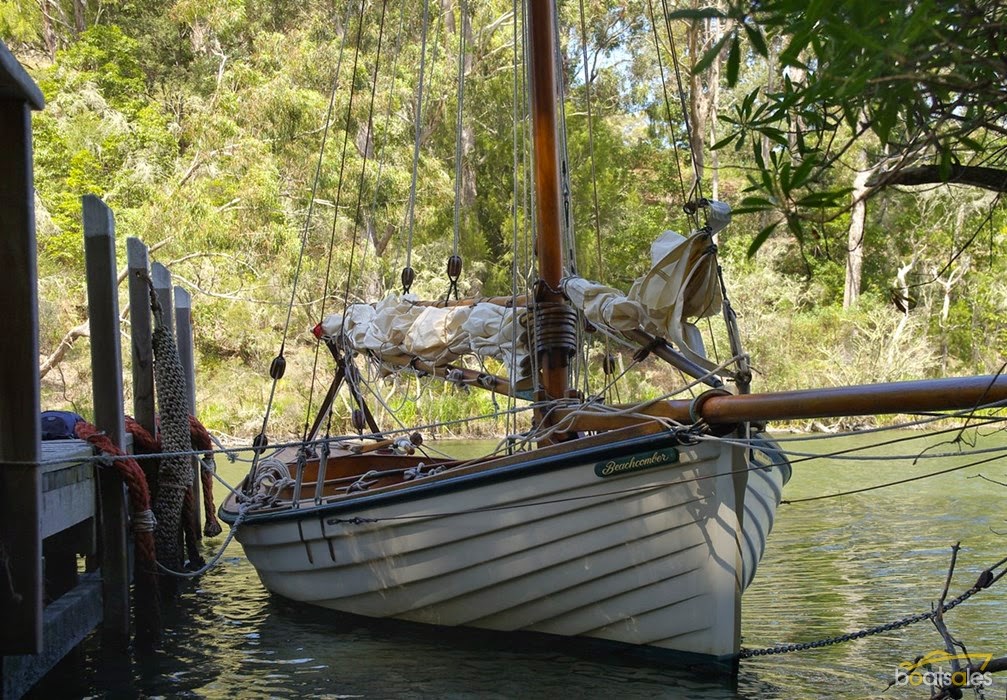
We'll include some more details about Beachcomber here, bearing in mind that she is still a long way from us and we only had one photo session so far. The upper pic shows white beech decking, Merbau combing and belaying pins, oregon mast (of incredibly fine grain).


Sitting at the helm is a delight. The restorer, Fred Herbert made wonderful use of his skills as well as those of some of the most talented local lakes shipwrights in detailing the project. The timber has not had its annual attention this year and is beginning to look a bit tired. I will try to protect it without removing too much of the patina.


 The boat was locally built somewhere between 1860 and 1870 to be the supply boat for an isolated station (big farm) on Whale Head. The maker was probably English and believed to be named Tierney. The design of the boat owes absolutely nothing to local traditions as it pre-dates the typical Gippsland fishing boats designed for the Lakes and other 'Couta Boat' styles which generally were developed later for deeper water elsewhere in Victoria. Fred has some wonderful details of her history, even photos of the boat in the 1940's, when it had already been called Beachcomber for seventy-odd years.


The counter stern has the effect of emphasising the curve of the sheer line. She is very sweet from all angles.


She does have a 10hp Yanmar diesel on board, supported by twin batteries. The centre plate is of boilerplate iron encapsulated in epoxy. The hull timbers are the original New Zealand Kauri boards, except for the sheerstrake which was new Kauri in 1992. She was re-ribbed in local Eucalyptus hardwood at the same time. Doryman, I confess that although there is a hand powered bilge pump, there is also an auto electric one that discharges into the CB well.

She draws about two and a half feet and is twenty-four feet on deck. The blocks are all hand made and all fittings are either copper, galvanised or bronze including the standing rigging (galvanised and possibly in need of replacement) The running rigging is all natural fibre too, and I'm not sure that I'll be able to maintain this level of purity! The gaff jaws have only ever been lubricated with real tallow. In addition to the penny placed under the mast, there are silver coins of the realm on every wooden block, but don't tell the Queen.

Wednesday, March 4, 2015

introducing 'Beachcomber'


I would like to introduce Beachcomber to both my remaining readers. At this point she is about half ours (although she is so old we regard ourselves as custodians rather than owners), as we tidy up the details of registration and insurance.