Showing posts with label Annie. Show all posts

Tuesday, March 7, 2017

the edges of things


The most productive places are sometimes also the most interesting. When we think of a landscape we often picture the spaces and the expanses, and while these provide the tone or the texture to our image, it is to the edges that I am constantly drawn and these are often the most productive too. It is  called the 'edge effect', where energy or diversity is concentrated and systems become more complex and productive. Bill Mollison used the power of this effect elaborately and extensively in his  invention and application of Permaculture principles in 'edible landscapes'.


 Edges provide perspective. When we are on water, we look landward. When we are on land some of us seek  places from which to look out over water. Water reflects and  is reflective also in the sense that it allows us the distance to consider.


A thing can seem more delightfully real when edges are emphasised- perhaps by increasing the tonal difference between surfaces. A subject can be made more beautiful by softening edges that distract from those which are essential. In abstraction, sometimes the edges become the subject and remain beautiful without being elaborated by reference to things as they appear to be.

Cultural diversity creates energy at the edges too. It always has. The greatest cities, trade routes and ports have always generated excitement, energy and productivity because of the interaction of contrasting cultures- which may be homogenous at their centres, but porous at the edges.

The images here are digitally modified photographs.

Wednesday, January 11, 2017

waterline, weather and leather


There are dozens of reasons why a trailered boat shouldn't wear antifouling below the waterline, and I have chosen to do it anyway  now I'm in  a situation where I can sail often because the boat can spend weeks in the water if I wish. The bliss of this is not lost on me.

Whereas before we moved here a sailing day needed to be chosen carefully, planned for and then travelled to- with the possibility that the morning could be wasted if the weather was ordinary (or worse)- now if I get the weather wrong, I can be much more philosophical about it, and maybe treat myself to some uncomfortable lessons in the wrong conditions, and then take my little tail home for comfort, without getting in the car.

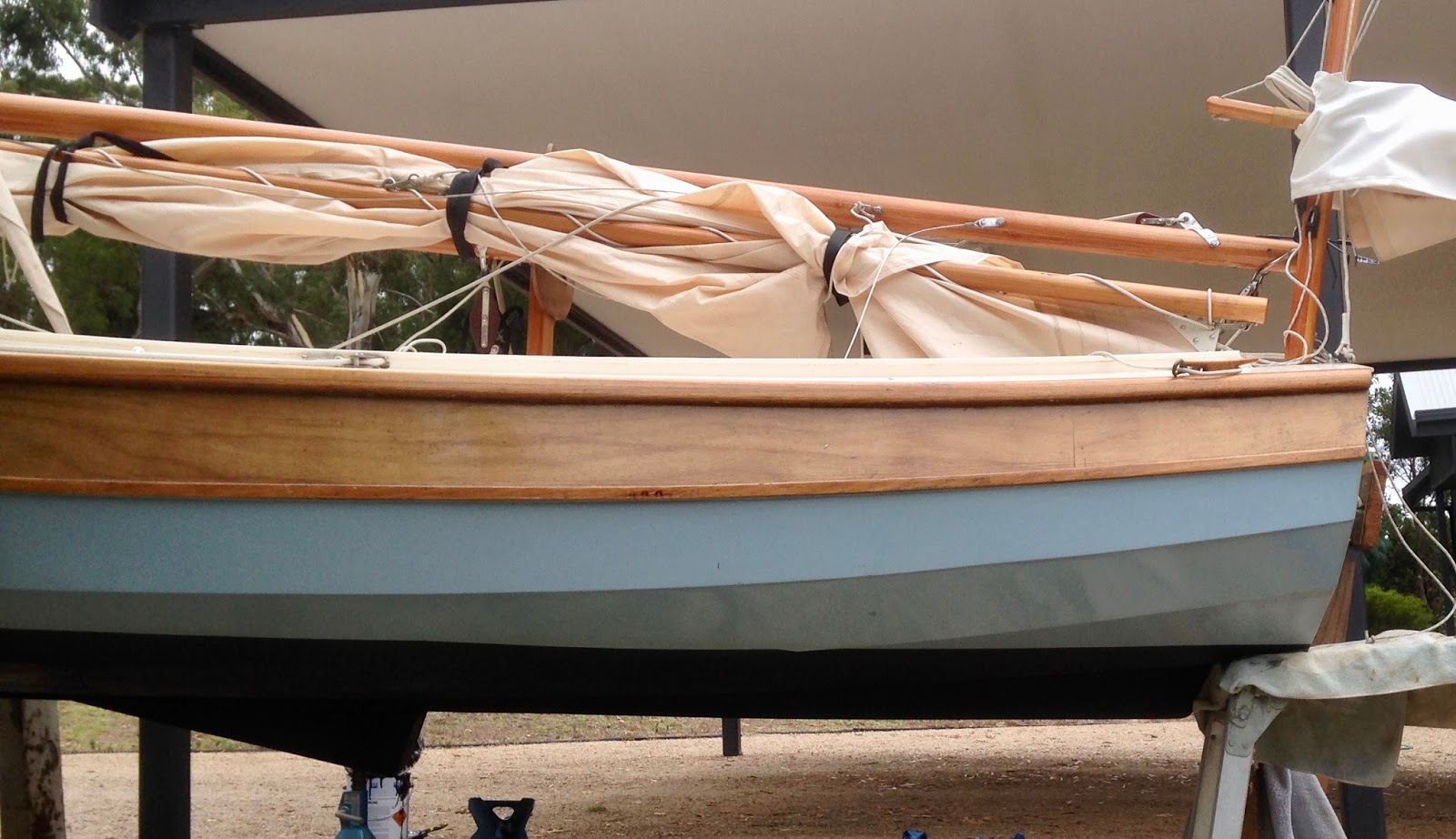
So she has had the business- black antifouling below the waterline after I scraped the growth from her bottom again (not a comfortable thing to do on a bottom that is so horizontal, and so close to the ground). The pleasure for me this time was to figure out a way of getting Annie off her trailer without lifting anything. This was all achieved with a few clamps, a pair of saw horses, a few boards and a horizontal platform.


The trick is to lower the trailer dolly wheel, which lifts the stern. Slide in an angled support just under the stern, then raise the dolly again- on a block of wood if necessary- then place some support across the front (a 4 x 2 on edge, or bigger) on saw horses spread wide enough to clear the trailer wheels. Lower the dolly and then move the trailer forward, under the beam and out of the way. For this trailer anyway, the beds were now well clear of the hull. Your back is spared, but do be careful if you try this. I always add a couple of fail-safe back-up braces and supports before working under the boat.


Last time I went out the wind was up and threatening but the forecast was for it to ease so I had an interesting sail under mizzen and jib for an hour or so, and was quite pleased with her handling and tacking in those conditions. The wind then turned and made a part of the bay very rough and messy and another part more sheltered, so I raised the main without a reef and had a great couple of hours reaching back and forth over a longish gap between Bell Point and Shaving Point in a fresh wind on a rolling swell. To keep the boat level and just because it felt good, I sat out and sheeted in for  an exciting ride. 

The Navigator can usually be sailed without hiking out (especially if sail is shortened to suit conditions) and so the extension is a discretionary tool really....but I like it. This was my longest period using the tiller extension and it worked a treat, but my sweaty palms eventually began to struggle a bit on the bare wood.


Because the extension often needs to be out of service I designed it to sit low over the curve of the tiller so as not to get in the way, and it sits on a little locating pin so as to stay put. Both the tiller and extension flair out slightly towards the ends and this makes gripping easy, but I've added some leather on the extension just to make it less slippery.                                       I considered thin line, servings, turks head knot work etc and couldn't find a rope work solution that fit my purpose, but finally settled on leather because this is the traditional technique I used to replace the leather grip on violin etc bows. It feels good, looks restrained and doesn't add much to the bulkiness of the rod. The edges are rounded over so sit tight on the timber by means of a cut bevel on all four edges. This is done with a razor sharp chisel on the inside face of the leather. The leather was then treated with a product called Dubbin- used here in the past for treating boots etc without adding colour.


Monday, January 9, 2017

if I were a wave


If I were a nasty, bolshy, fulsome, front-on trough of a wave, I'd be struggling to suck her down with all that firmness of  bilge and flare in the forefoot, if I wanted to get the better of Annie. She's so broad...


If I were a rising, cresting, crashing wave coming down on her stem, I'd have nothing to get hold of if I wanted to push Annie abaft, there's nothing to grasp. She's so thin...


Now she's having her bottom scraped again, but you'll be relieved to know that she and the wave lived happily ever after.

Wednesday, December 21, 2016

the speed of our weed


Initially, Annie was to be in the water for a week or so, but then she started taking me out onto the lake in the mornings (she made me do it), and pretty soon it was more than two weeks...and we wanted her in the water for Christmas, but a timely reminder from a friend about the speed of our weed in the creek prompted me to take her up for a bottom scrub. 

I was surprised at how much biology had attached itself to her hidden bits. It took more than the pressure from a hose to loosen the stuff, and I resolved to antifoul her at some point soon.


In the carport again, attending to a few details over a couple of days, she is ready to launch, but this time I'll try to keep track of time. She now has a wooden jamb cleat on the underside of the tiller to hold a bit of line or shock chord (interchangeably) because there are times when the tiller needs to be held without me. Also I shortened the tiller extension by about 5mm to allow a wider swing of the tiller when the extension is not in use (it sits on a short brass locating pin to keep it from falling about).

And now a note for Russian readers:

Я заметил значительное увеличение числа посещений этого блога из России, я бы очень рад, если кто-то может позволить мне знать вероятные источники этого интереса и если я могу сделать больше, чтобы поддержать его.

Thursday, December 8, 2016

Navigator Annie in retrospect: fitting her out


Having Annie at the jetty this week (instead of trailered and covered) has enabled me to fine tune a few things that I used to be in too much of a hurry to worry about. But the details are really sweet- they give rise to pleasant little operations and habits that are almost as therapeutic as sailing....so I thought I'd share a few of the details that went into my boat, especially since the book I wrote about the Navigator didn't feature many finished details of my boat at all. I felt strongly in writing it that the book should be about the design in various hands, not simply mine. It is in the details that your boat becomes an expression of your priorities and methods of operation.

So I offer these thoughts in that context- and with the reminder that there are a few excellent videos and tips about other methods of set-up available online from Joel, navslipjig and others.

Let's start with the pic above. This is all packed up for transport, with a boom crutch at the other end, and here the tabernacle top bolt supports the mast, with the yard and boom under it, sails all still attached. The tabernacle is detailed in my flickr pics (-RHS margin of this blog) Hanging off the cleat is the mizzen mast with it's sail still on too, and it is suspended there for transport by the forestay. It is still attached to the furled jib which is, in turn still attached to the pad eye at the bowsprit. This is incredibly quick to deploy and very compact. The only downside is that the gooseneck maximum height for transport is limited by the height of the tabernacle, but I have it where it stays anyway.


Above is the boom crutch; mast on top, boom below on far side, mizzen near side.


I chose to make a sort of 'push-me-pull-you' to link the CB to the tackle because in this design the top of the board disappears into the case when lowered, and a solid link is really useful in either direction if something gets stuck. The CB case lid can also be removed with two through bolts if necessary, but I never have. Until today, I needed to leave the helm to lower the board if there was forward movement or strong currents because the tackle has a certain braking effect, but a simple line fitted from the front of the wooden member, led back to the CB cleat at the rear of the case has meant that I can raise or lower from the helm.


Not needing to leave the helm has many advantages. Left shows the throat and peak halyards and the topping lift on their way back to cleats on either side of the back of the board case. From the helm, the main can be raised or lowered and the jib unfurled, without leaving the tiller.

Below is a reefing block made from teak over a shop bought nylon sheave, and below that the same method to make one for the rudder downhaul. These are really easy to make and little blocks like this aren't cheap to buy.


 below, the hull was turned (on hay bales) with the main sheet block for purchase. The rest of the pictures are just bits and pieces that give pleasure in the making and in the using. Many of these fittings would be useable on any small craft.


the beginnings of the tiller


all the horn cleats are from Australian hardwood. Of course you don't need to make these things, but they are a pleasure to do if you can make the time to do them. I made a side profile pattern from ply, used it to trace out a number onto a board then cut out the profiles. Knives were used to cut bevels and gradually round them to a pleasant shape, but you could use chisels or rasps.


tiller and extension from teak and cypress


making the tiller extension swivel joint from sheet brass


Always a happy boat for me


Thursday, December 1, 2016

sailing Navigator Annie after way too long


Across the creek from us there is a sort of ramp...well it is more a gap in the bushes really, but after far too long (what with moving, renovating and the charms of Beachcomber) I thought I'd try this little sandy spot for a launch of Annie. The trouble with the jetties around here is they are generally set a bit high for compact and lower boats- I always feel I need a truckload of fenders.


 The vehicular part was fine in 4x4 mode and she slipped effortlessly into the creek. I knew the foliage would prevent raising even the mizzen mast until after launch, but there was a nasty breeze blowing straight up from the south and in such a confined space behind the jetty pictured above it was necessary to cast off and tie up to a couple of trees in very shallow water to rig.
The spars had been revarnished before we moved so lines were all in the wrong places and it all took much longer than usual.


The sailing was certainly worth waiting for and Annie spent a few pleasant hours exploring Bancroft Bay and our bits of Lake King. Other gaff sailors will all have their ways of raising the yard, and with Beachcomber I like to see it going up horizontally until the throat is within cinching height, and then the peak can be trimmed. I had forgotten that the forks I made for Annie are a little tight to do that smoothly, so hers tends to go up with a fair bit of peak halyard first, and she likes to come down the same way. I'll have to get some tallow onto the leathers all the same.


Saturday, April 9, 2011

stop curling your sun-drenched toes buddy- I've got wings


This tiny clip is probably best watched in full screen mode, but don't hold your breath for a plot. It merely represents a moment of surprise and pleasure, when the little electric pod did everything I had hoped for it, but with even less fuss than I had expected.
At this point we had already discovered that the boat would float. Always a good start. More than that, the centre-board pin was not leaking. More good news. But all of this is to get well ahead of myself. Not unusual.

I was standing outside my workshop an hour before this with a gusty, enthusiastic northerly busily rearranging what is left of my hair. I'm thinking; 'I'm going to test the results of a year of work in this?' Plan A was just to see if she floats, with an extension plan based around seeing how much I had stuffed up the installation of the electric pod. My lack of confidence was to be dealt with by the presence of a petrol outboard, to save face and give an impression of someone who knows what he is doing if the pod fell off, or fizzed excessively, or failed to move the boat against the wind or current, or jellyfish or some other obstacle sent by the powers that conspire to keep my ego in check.

They all failed. Everything worked.

Which meant that getting on with sailing would have to be the next challenge.

By the time we launched the wind had magically fallen away to a lazy blow, the sun was out and she had been rigged easily within 20 minutes- and I was being slow, precise and careful, it being her first time and all...(without the outboard and with some practice this figure will no doubt improve, especially if I feel like moving a bit more quickly).

I decided that given the morning's anxiety about gusts, I'd start with motor and lazy mizzen, progressing to jib and mizzen if all went well, but the idea of raising the main was not given much consideration until after about ten minutes of relaxed sailing in a gentle breeze, up went the main from the comfort of the cockpit, and without leaving my seat. Such luxury.
I was absolutely gob-smacked (after the luck of having such success with the pod) to find that all systems worked, and despite my own short-comings as a sailor, Annie was having a lovely time anyway.
She was a delight. Tacked easily despite me, light on the helm, lots of nice places to stretch out a naked foot and wiggle the toes in sunlit sheer delight that I was alive and THE DAMN THING WORKED. Arm over the coaming, breeze in my face. Jib furler easy and very helpful, main sail pulling us along, despite the pod, even in a very light breeze.

One or two gusts came out of nowhere, and there I was with two sheets in one hand, my son on the phone in the other, and the mizzen seeming to just let me do my own thing without any great demands on my attention, when all of a sudden, I looked up to the main that seemed suddenly very big and quite capable of something very powerful, and Annie said 'stop curling your toes in the sun buddy, there's plenty about me to see yet. I've got wings and I've got lungs and if you play your cards right we'll have some fun....one day'.

Julia and I had a really lovely, lazy sail, and then I had a blissful potter on my own. Love it.

Thanks for the design Mr. Welsford.