Showing posts with label boat building. Show all posts

Saturday, August 26, 2017

at last, a story of inclusion


Image may contain: 6 people, people smiling, people standing
The following is a post from 'Humans in Geelong" concerning a project to build St Ayles  Skiffs, but the build of these two boats is by some Syriac people from Iraq who find themselves here in search of peace and safety. It may only be two boats and a smallish group, but this is a monumental piece of community building through education and creative effort. Stories of inclusion and empathy and shared skills are so rare but never more important than now with so many voices in the West actively trying to instil irrational fear in our populations, trying to build intolerance and prejudice from insecurity. 

A light emanates from the workshop in Deakin University Waterfront Campus. The sun is setting and most people are dispersing to the car parks at the end of a long day of lectures and studying. After a while, only a dozen people remain, working away on a project that intends to span years. The dream: a Pako Festa on water, with a dozen hand-built wooden boats bringing together a multicultural community for exercise, festivities and fun on the city waterfront. 
For many of these builders, however, they have never seen a boat before. The Syriacpeople of Iraqi who are working on the boat alongside Geelong Iranian Society - G.I.Shave escaped devastating conditions under ISIS and travelled to Australia seeking refuge from their war-torn country. 
The youngest of these is just 16 years old. For the Iraqi refugees, their ancient hometown of Bakhdida (modern-day Quaragosh) is just south of Mosel. It was occupied by ISIS and reduced to rubble in the ongoing conflict. But, Peter Doyle from the Royal Geelong Yacht Club tells me, the refugees don’t let these tragedies define them: they are focused on and enthusiastic about their future in Australia. He adds that most of their conversations focus on mundane topics such as football, and I notice small buzzing conversations across the workroom in between the buzzing of tools.
The project, launched in May this year, has a goal of building 10-12 boats. Based on Scottish coastal rowing boats of early last century, the St Ayles Skiffs were designed by Australian boat builder Iain Oughtred who now lives in Scotland. Built entirely from Australian timbers, they are delivered as flat packs and assembled with epoxy with not a screw or a nail in sight. What I really enjoyed from learning about this project was the sheer joy, enthusiasm and welcoming environment that I found myself in. It was with great enjoyment that I watched Peter rifle through his photo album of these skifs from all over the world. “Isn’t this one gorgeous!” he tells me, pointing at the photographs of handcrafted wooden skiffs in his folder. 
As for Peter himself, he is retired and is now dedicated to his passion for boats, bringing these boats and their builders down to the Waterfront for the Wooden Boat Festival Geelong in March. In an incredible feat, one of these skiffs was towed across the Nullarbor from Perth to attend last year’s festival. With many smiles and an increased knowledge of boats, I left that evening to allow the group to continue to work with the warm light of the studio emanating through the approaching night and the clangs and whirrs of the tools the only sound that remains.
I returned on a sunny Saturday morning with our photographer Phil Hines in tow and was pleased to observe the workshop in full action. Since my last visit, the very first boat created by the group had been named: Bride of Bakhdida. On the whiteboard in the workshop, the name of the boat is written in the Syriac script. That name will be written in both English and Syriac on the boat upon its completion, signifying the unity between the Geelong and Syriac communities and reflecting Australia’s multicultural nature. Further demonstrating this fusion, on the whiteboard is also a list of boat-related terminology in English, Syriac and Persian (the language of Iran). ‘Hello’ is shlama lekow in Syriac and salam in Persian. 
I spoke with Arash and Shiva about the decision for the Iranian community to collaborate with the Royal Geelong Yacht Club in building these boats but I was swiftly corrected: “It was all Peter’s idea,” Arash insisted. The glowing praise for Peter’s work and commitment to bringing Geelong’s ethnic communities together to build and use these beautiful boats was extraordinary. My final question was what they were the most excited for in the near future for the project. “Seeing the first boat on the water,” Arash replied. “That will make all the difference.”
Written by Stephanie Downing. Photo: Phil Hines Photography


Sunday, June 11, 2017

Welsford navigator 'Annie' build slideshow


To celebrate more than 1.5 million views of my boat building pics on Flickr- half of which are of the building of the Welsford Navigator 'Annie', I have put together a five minute slide show of the build process as it happened for me. 
In writing, emailing and talking to dozens of Navigator builders since posting these some years ago, I know that having pictures and resources available is a big factor in motivation for some who are facing these challenges for the first time, often with little experience in the shed, or 'on the tools' (as Australian tradesmen express it).

I hope this is of some use to builders- particularly of Welsford designed boats which all share some common build and design features. The Flickr pics are somewhat annotated and are more useful for careful dreaming, but maybe a slideshow might be of use in big picture dreaming when you should be doing something normal, but need a boat building fix.

Mine isn't the prettiest of Navigators, nor is it the best build. I'm certainly not the best sailor or the best film maker or the most adventurous owner. To be honest I love timber and lines and building challenges most of all and sailing is something I came to very late in life. The workshop in which most of the build happened is crude and agricultural (although some bits are nice when I took it to my place of work) but the boat functions well and the pics have been feasted upon because they are there to be seen.
There is also the book 'Something About Navigator' (available on Amazon) which people tell me has been useful. I think I earn about $3 per copy when one sells, so please don't think this is a commercial plug- I wouldn't have bothered for the money! The black and white edition has pretty ordinary illustration quality, but I had strong advice at the time that I needed to keep the cost of the book down to $20. The colour edition is better, but twice the price.


Navigator 'Annie' build slideshow from Robert Ditterich on Vimeo.

Friday, May 5, 2017

nobbling the last of the ugly spots


A handy storage pocket and a bit of lining on both sides of the hull complete the visual simplification of the Bandicoot's cockpit. Below, these less than artful stringers have been magicked away. Uneven or poorly textured surfaces, lines and shadows create a visual 'clutter'- without being necessarily particularly noticeable. This visual noise makes it more difficult to appreciate a nice space.

At the moment I'm resisting the temptation to add wooden trim, just keeping it simple, at least until the cushions are delivered.


I'm not tempted to line the canopy because I actually like looking at the structure, and it would be needless added weight.


Monday, April 24, 2017

it's the process that rings my bells


Well I hope you can forgive the low graphic quality of the drawings shown below. You see that the final draft didn't even make it to ink....just a pencil drawing smudged and reworked over weeks until I found what I was looking for, to overlay upon the original lines. There were many other drawings, but ultimately I decided to take a few shapes that worked for me and emphasise them, while at the same time doing the simplest things possible to de-emphasise some of the shapes that annoyed me.


So for the moment, it is down to the details (and I was never a details kind of person) and the second coats of top paint on several edges and surfaces, and a fuel gauge that persist in defying me, and waiting for the upholsterer, and painting the cockpit floor, and other stories....


Friday, April 21, 2017

lids, lockers and mucky painted fingers


Bandicoot has a very generous cabin and the rear cockpit roof makes a third space which is very useful, but my thinking has been to keep it as simple as possible. It is very wide but not huge in depth, so I decided to make a built in structure across the full width of the transom with a movable step which also has storage. This means that access, seating and storage are combined to leave as much uncluttered floor space as possible. When needed, this allows space for a couple of portable deck chairs.

We have decided to use a local business to supply upholstered cushions and 'sunbrella' fabric side and rear curtains, but because they are very good in what they do we will have to wait some months before the boat gets the benefit of their work. I love supporting local enthusiastic business, but I'm not very good at waiting. In the meantime I'm painting the rails and side decks and preparing grab handles for the new roof. The cabin roof and sides are also being repainted.....I can't believe how much painting I find myself doing, it really isn't something that I particularly enjoy. Incidentally, I'm using Sikkens Cetol Marine Varnish for the two step/storage lids because I've found it easy to retouch on Beachcomber's decks, and quite hardy. The surface isn't as glossy or beautiful as with a traditional varnish but it can be recoated easily without sanding and I've learned that ease of maintenance counts for a lot in wooden boats.


Saturday, April 15, 2017

a marriage of shapes


Who said 'the devil is in the detail' ? And who would have thought there would be so much interest in a blow by blow record of the goings-on of this boat? She doesn't even have a mast...Despite there being very few comments, these little blogs of Bandicoot's new lines and nuanced features are getting a surprising number of views. TV must be at a low ebb at the moment. So these pics are about the marriage of a cockpit roof with a cabin. Finding the lines that define. (I was never fond of the shapes at the back of the cabin)


A most unlikely pair of shapes to harmonise the line of the new roof with the angles of the cabin.


Below, the old edges visible through the fairing compound.


Meanwhile, between painting sessions I'm making a seat base/step/esky cover/storage box/table for 500 mm along the transom. 2 x 800 seats, 1x 800 decked surface. The decked bit is on a piano hinge which allows opening to access cool liquid and picnic foods...A proper multi-function gismo that hides a multitude of messes and provides a convenient step down into the boat from the rear (under the hatch). The seat bases cover acres of storage space. We will have to wait for the upholstery that will make the two side areas into decent seating. A bottom step with storage is also being hatched in the wings....


Friday, April 7, 2017

clearing the benches (gimme shelter)


When the day came that the roof was weatherproof enough, and the paint cured sufficiently, the usual self doubts arose about the difficulty of moving the roof, of whether it would fit- having been built remotely from the boat, whether it would make a difference to the comfort and shelter on the boat, and whether it would make the boat look worse rather than better.


 Julia and I and a great pair of friends carried the roof from the ute, along the bush track to the jetty and lifted it on just as I had hoped we would. It slipped straight onto the notches provided and the temporary posts clamped to the coaming made it pretty level at their prepared height.


Despite drawing various positions and angles for the posts, it has been easy to find the preferred alternatives by clamping timber as below. It remains now to fix everything down, and harmonise the edges and transitions so that the structure looks to be part of the boat, not just an afterthought. This will also involve re-forming the cabin rear side edges (to an angle that echoes the angle of the windscreen).

In the hot afternoon sun it was pleasant to sit under the new roof, the four of us having a quiet beer. 
It fits.

Tuesday, March 28, 2017

beams, logs and scuppers


The frame of Bandicoot's cockpit roof looks like some sort of puzzle, but skinned in ply it looks so simple, I wonder what all the fuss was about...


Friday, March 24, 2017

a two bench job


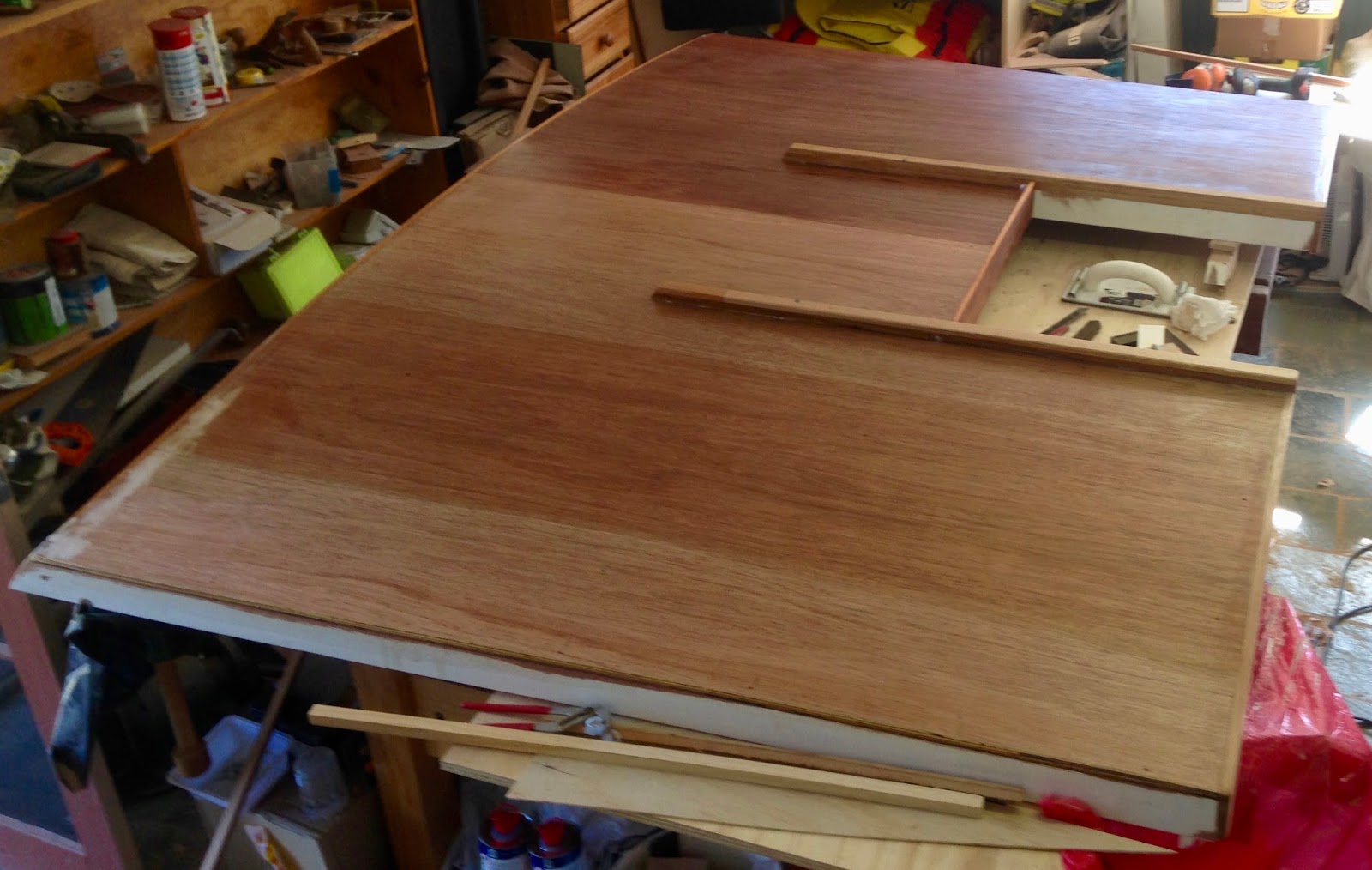
Not really 'benchwork' when you bury two good sized benches under the 'piece' and have cascades of off-cuts, tools and timber all over the floor. I'm proud to say all of these pieces  are from timber I have saved from other jobs, some going back decades. This is a cockpit roof for Bandicoot. The really tricky part has been accomodating the asymmetry in the back of the cabin and the cockpit itself. Measuring up on the boat and re-creating it in the incomplete workshop has required endless triangulation and small adjustments in all three dimensions...I sure hope it fits.


 By covering the cockpit, Bandicoot is morphing from a utility (truck) to a wagon and I thought there may be some interest in the process involved. Covering the cockpit will add to the all-weather use of the boat I hope.The hull tapers in a gentle curve from cab to transom so the rails will match the curve of the coaming. I'm just building a roof, the sides will be open roll up canvas.


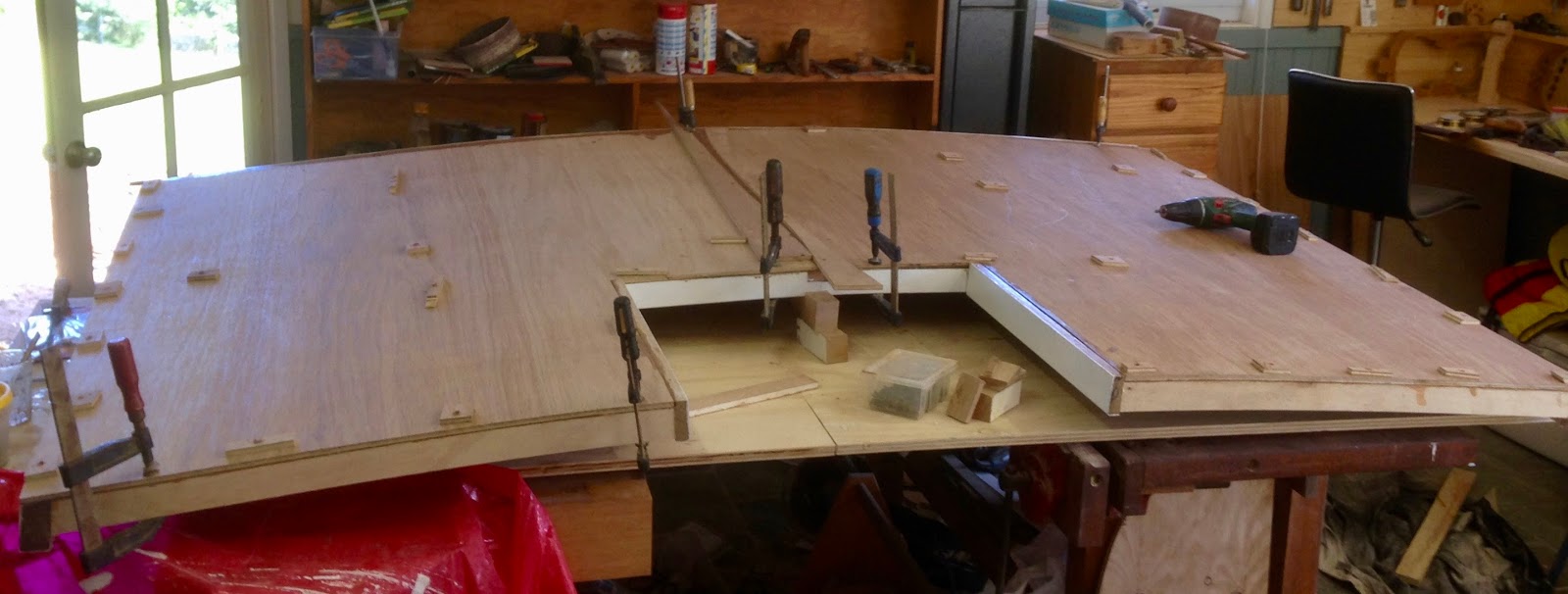
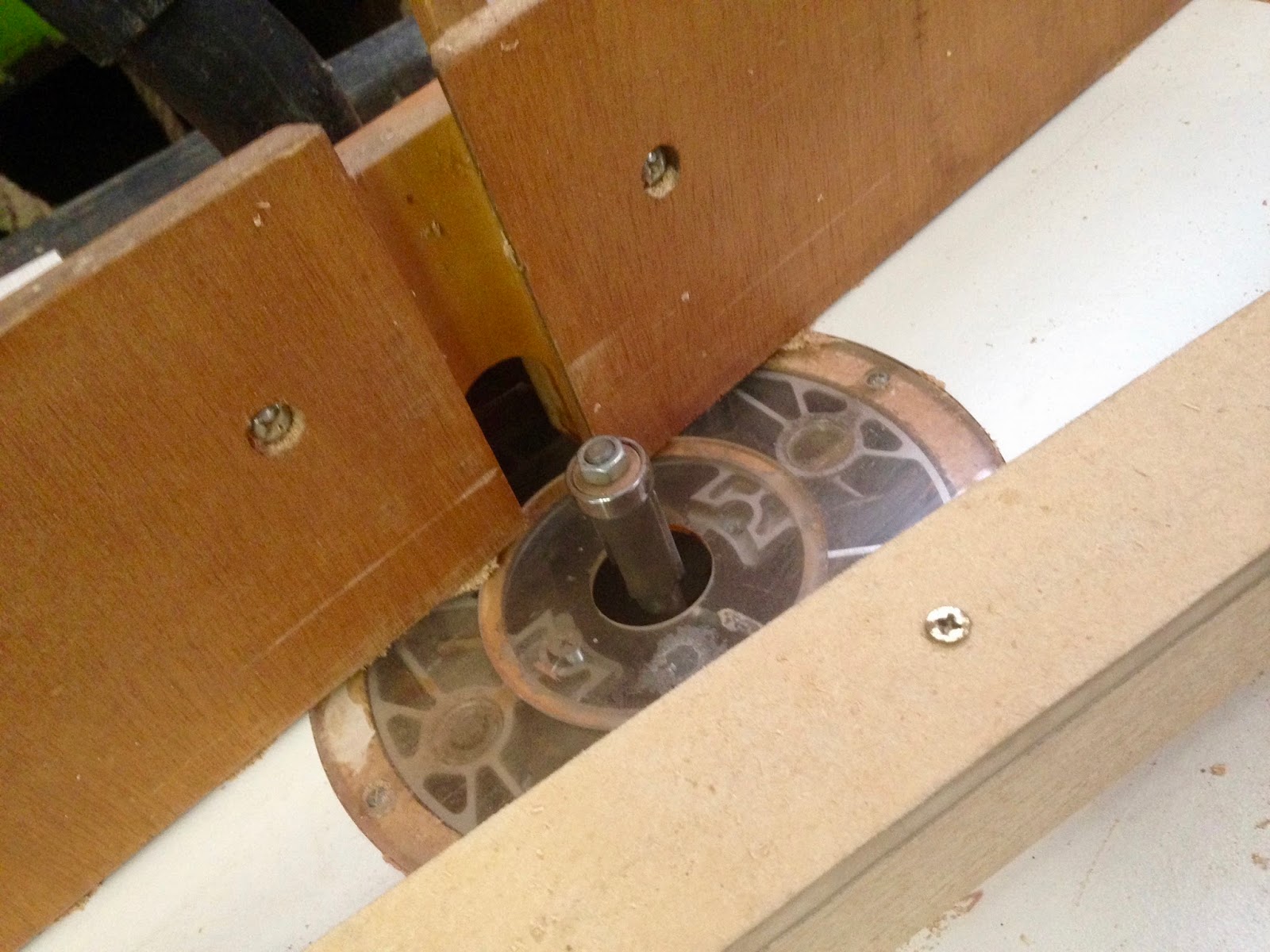
All of the roof beams are from Philippine Mahogany reclaimed from our house renovation. By making half widths it was possible to squeeze three pieces out of each old rafter. These were pattern routed with a flush trim bit on my router table.


Clamped together, the beams could be accurately rebated to accept little ties or purlins. They form the only right angles in the entire structure. In the old measure the roof is about 9ft wide and these beams have been rather labor-intensive...


Sunday, March 12, 2017

Emphasising the horizontal- Bandicoot trim


Two pieces of trim seem to have taken an inordinate amount of time and material. The sun visor has a practical purpose, but the trim strip and visor were considered mainly ( if I'm honest) because I wanted to de-power some of the verticality in the very high cabin lines. I hope that the visor gives the roof a longer feel, instead of just being 'folded' down from the very large windscreen. The tall slab sides and not particularly elegant (but great to look out through) side windows have been broken up by the dark trim line which runs as an extension of the edge of the lower roof line.
.

This little visor was nearly 9ft long and was constructed from five pieces of 9mm marine ply. Below; upside down, the angles are to nestle the unit against the compound angles of the three windscreen panels.


The visor having it's final dry fit.