Monday, April 18, 2011

magic few sails in glorious April


It would be good to try to organise some thoughts about these first few sails of a yawl, and this one in particular. Whatever things I say here will be spoken like an inexperienced sailor, and my observations may seem simplistic to some, and should not be gospel to anyone.

I've taken a few opportunities to sail Annie alone, and the weather has been very kind to me- but my aim in doing this is to spend some time just trying to listen and feel, and see what Annie has to teach me before I go off with the distraction of crew and passengers to talk to. This has really paid dividends already because it is one thing to nut something out intellectually, but quite another to follow a line and give it a nudge either way to see how it all feels through the fingers and seat.

Take the issue of weather helm and mizzen tuning for example. On my first outing in Annie, in very light winds I was having an easy, lovely time, but when a gust came the tiller didn't do the things that it does to my fingers in a sloop. The boat didn't ask me to spill some wind or let the tiller slip a'lee, because in those light conditions I had the jib sheeted up like I would have in a sloop. The result was an incredibly light helm, or even a bit of lee helm. It seems to me that makes for very relaxed sailing, but if things go awry quickly it is helpful to have the helm wanting to round up the boat into the wind and decelerate all by itself, with no help from the skipper, whose mind might, at that moment, be on other things....On the other hand, an overly heavy helm is hard on everything, including the fingers.

On a sloop, the helm can be balanced or tuned by adjusting the stays for mast angle- back for heavier helm, forward for lighter (speaking generally), but you can't do these things without leaving the comfort of your seat....

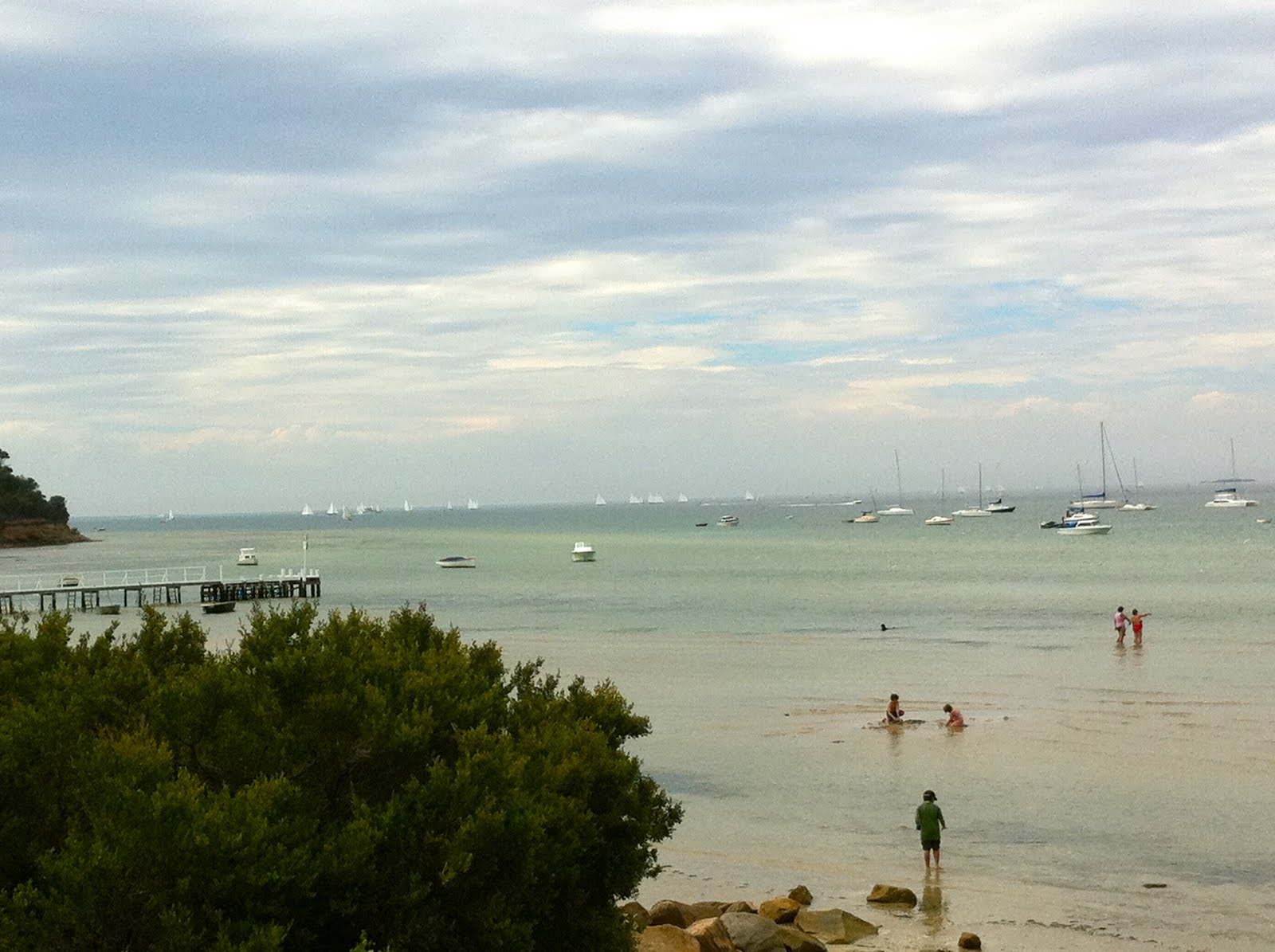
Anyway, that first sail taught me a lot and I came to the second and third sails wanting to be more tuned into the needs of the mizzen and jib in balancing the rig for comfort as well as safety. To-day was great weather for finding some skills and practicing some drills. I had all morning available, and a wide expanse of Corio Bay to myself except for a few anchored ships and small fishing boats dotted around all the likely spots. Not another sail to be seen. Wind was steady and I took a very long beat from one side of the bay to the other with no other objective in mind than to feel what could be achieved by balancing mizzen against jib.

So, heading to windward I found a useful groove for the windspeed and just let out the jibsheet till I felt the mizzen pulling a little on the tiller. It's great to have the main and jib sheets coming from the same direction, but in these conditions I just cleated the main and see-sawed the boat from mizzen power (weather helm) to jib power (lee helm) without changing anything but the pull on the jib sheet. (The mizzen was sheeted fairly tight throughout the whole beat) For a small-brained simpleton like me this was fantastic- and it was like learning to actually feel the mizzen on my tiller fingers as it powered up relative to the jib. So finding the groove when the boat was in balance soon became more automatic, but still fluid as the wind raised and fell away. If I let the jib go out too far it told me by flapping, so the ears were learning just like the fingers....maybe the brain will catch up soon.

Second time around the bay the wind picked up on a beat and the hull came to life but I felt confident enough now to hold the course and let the wind do its best with me without giving any sheet away. It suddenly felt very grown up. Not content with that I sat out with the tiller extension and let her rip, having the most exhilarating solo sail I've ever had. The boat repaid my trust and gave me some speed, and I have to say, the boat feels like a different animal altogether from above the coaming with me looking down the bowsprit from an exulted height. It seems bigger, and very resolute.

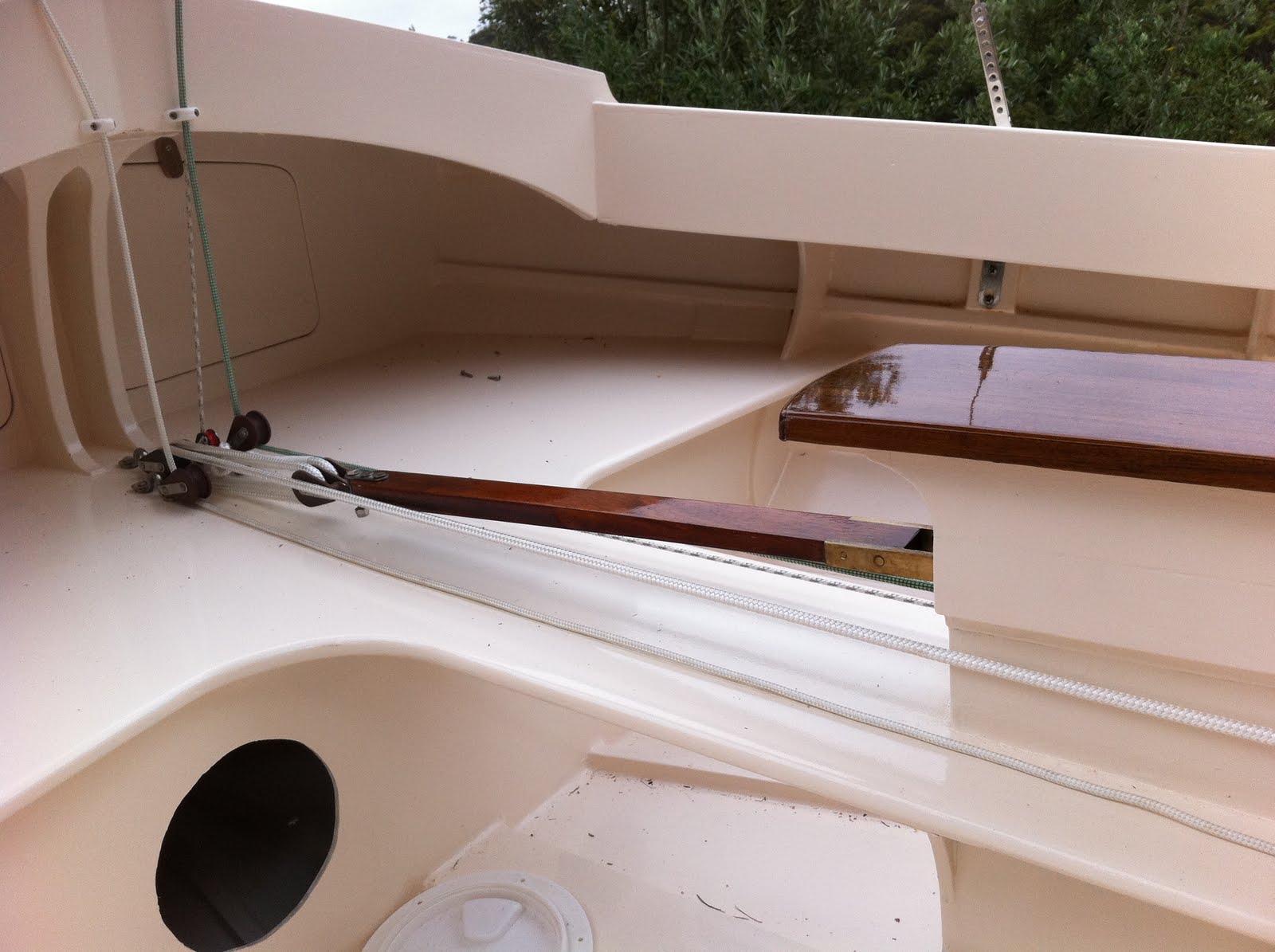
One thing I'm really pleased with in the laying out of my fittings is the angle and positioning of the sheet cleats. I think for inexperienced sailors, in particular, it is incredibly important to have them carefully angled so that they are easily engaged, but more so in disengaging them - they need to be angled so that even just pulling the line will release them. First set of my jib cleats was nearly right, but was just a tad hard to cleat off without reaching forward and pulling down. I angled these up a little higher and now it is easy. Maybe stating the bleeding obvious, but a couple of degrees of orientation might save a lot of embarrassment some day.

Oh, and the little uneventful clip up there is from the second sail. To-day I was having too much fun even to answer the phone let alone film anything. Sorry....

Monday, April 11, 2011

the buzz and the box


This is to detail the installation of the electric drive after a very satisfactory first trial. The pic above shows the battery box, which is simply held captive by slotting over the keelson, and held fast when the lid is slid over the box and the catches engaged. The grey plug is an 'Anderson plug' and is an easy way to disconnect the battery. Behind that is a black plug (with waterproof cap) into which the battery charger is plugged. In our case, that battery charger is powered by homegrown solar electricity from our ten year old household power plant. There are various additions and refinements possible here, but I'm keen to keep things as simple as possible.

Incidentally, the wooden thing there is the boomkin in repose after its first outing.
This complicated pic shows the control for the motor. When the knob faces forward the system is off. Turning it to the right gives a range of forward speeds, and turning to the left makes you go backwards. This is so much more fun than an outboard, and so incredibly easy to control.

What this system won't do is completely replace an outboard because battery range will always be a limiting factor without considerable weight and expense. But if you often launch from a marina, or simply want to explore a non-sailable stretch of creek or river, then this will be easier, quieter and much more fun than a stinky thing.

Now a small confession. The system as shown does not use the electronic components discussed in the previous post called 'power resistor versus mamba max'- it uses the resistor supplied with the motor, under that knob. The reasons are that I was quite concerned about the small scale electronic wires and connections in a wet, corrosive and hostile environment (managed by an incompetent with big hands and less than perfect eyesight). The consequences are that I won't get the efficiency that I had hoped for, but that simply translates into running time, and if that becomes an issue I can simply carry a second battery.

The major surprise in using this system was the positivity felt in controlling the boat. Because you don't need to 'start' the motor, or reach back to change from forward to reverse, and because the drive is in front of the rudder (and not going to cut great chunks out of it) the rudder is very effective under power; I can place the boat accurately and confidently. I've never felt that before with an outboard. I also felt more confident in approaching the marina because I knew that reverse was so easy to go to from the forward position.

As I expected, the motor compartment carries about 20mm of water, but this is easily drained, and it just requires that the motor wires are well (triple in my case) insulated. The waterline will be a little lower when the outboard isn't pulling down the stern too- particularly since mine is overpowered and weighted at 5hp.


Saturday, April 9, 2011

stop curling your sun-drenched toes buddy- I've got wings


This tiny clip is probably best watched in full screen mode, but don't hold your breath for a plot. It merely represents a moment of surprise and pleasure, when the little electric pod did everything I had hoped for it, but with even less fuss than I had expected.
At this point we had already discovered that the boat would float. Always a good start. More than that, the centre-board pin was not leaking. More good news. But all of this is to get well ahead of myself. Not unusual.

I was standing outside my workshop an hour before this with a gusty, enthusiastic northerly busily rearranging what is left of my hair. I'm thinking; 'I'm going to test the results of a year of work in this?' Plan A was just to see if she floats, with an extension plan based around seeing how much I had stuffed up the installation of the electric pod. My lack of confidence was to be dealt with by the presence of a petrol outboard, to save face and give an impression of someone who knows what he is doing if the pod fell off, or fizzed excessively, or failed to move the boat against the wind or current, or jellyfish or some other obstacle sent by the powers that conspire to keep my ego in check.

They all failed. Everything worked.

Which meant that getting on with sailing would have to be the next challenge.

By the time we launched the wind had magically fallen away to a lazy blow, the sun was out and she had been rigged easily within 20 minutes- and I was being slow, precise and careful, it being her first time and all...(without the outboard and with some practice this figure will no doubt improve, especially if I feel like moving a bit more quickly).

I decided that given the morning's anxiety about gusts, I'd start with motor and lazy mizzen, progressing to jib and mizzen if all went well, but the idea of raising the main was not given much consideration until after about ten minutes of relaxed sailing in a gentle breeze, up went the main from the comfort of the cockpit, and without leaving my seat. Such luxury.
I was absolutely gob-smacked (after the luck of having such success with the pod) to find that all systems worked, and despite my own short-comings as a sailor, Annie was having a lovely time anyway.
She was a delight. Tacked easily despite me, light on the helm, lots of nice places to stretch out a naked foot and wiggle the toes in sunlit sheer delight that I was alive and THE DAMN THING WORKED. Arm over the coaming, breeze in my face. Jib furler easy and very helpful, main sail pulling us along, despite the pod, even in a very light breeze.

One or two gusts came out of nowhere, and there I was with two sheets in one hand, my son on the phone in the other, and the mizzen seeming to just let me do my own thing without any great demands on my attention, when all of a sudden, I looked up to the main that seemed suddenly very big and quite capable of something very powerful, and Annie said 'stop curling your toes in the sun buddy, there's plenty about me to see yet. I've got wings and I've got lungs and if you play your cards right we'll have some fun....one day'.

Julia and I had a really lovely, lazy sail, and then I had a blissful potter on my own. Love it.

Thanks for the design Mr. Welsford.

Sunday, April 3, 2011

why is perfect soup so scary?


OK, we had Julia's pea and ham soup for lunch and it was perfect. So what is the problem? Well we had a perfect cauliflower soup last week, and last night we shared a magnificent seafood lasagne (by Julia) and a beautiful oven roasted sea salmon (by our dear friends Rob and Sally), and I'm trying to get a boat ready for launch. I suppose I should point out that these meals are hearty and warming- the sort of cold-weather fare that occurs when the weather is cold and the hearth beckons...hardly the sort of environment that says 'let's go outside and sail a new boat'...

The techno-bits have progressed to the extent that I just have to connect the battery box to the wires that now weave their way torturously through the seat box enclosures. The battery will sit directly in front of the centre-board case- a nice place for a bit of useful ballast, but I'm far from confident about my work with wires and connectors and small shiny boxes that do electronic stuff that I don't have a clue about...I'm way out of my comfort zone here and it has been a real struggle to keep motivated in the battery motor powering bit of this build. I would be so much happier with wooden wires and plywood electronics. But you never make progress if you stay entirely comfortable, and in a couple of weeks my apprehension will look puerile (with luck), or justified, maybe....

I told Joel that I would post something about the rigging, so will begin this here. Setting up the mast involves drilling nasty holes for the hounds, but like a lot of Navigator builders, I put them all in the locations specified in the plans, but then found that the jib block was too low to accommodate the extra length involved in the furling gear. So Joel, be warned- the jib halyard will be higher than specified, and to deal with this it may be worth having longer stays which can share the bolt hole for the jib hounds. My set-up is unusual too, because I've made a tabernacle for mast mounting, but apart from that, the Duckworks sails arrived in exactly the right shape and size, and set very well indeed on first raising them.

The long batten has been the subject of a bit of discussion, and many have chosen to use shorter ones- and I am open to correction should I experience problems sailing, but they set really beautifully, and I don't have a problem wrapping them all up for transport, so I'm entrely happy so far. The long batten makes the sail take shape even without wind, and the gaff set-up allows easy adjustment, without the common creases that the short batten fraternity seem to have. The gaff is a joy so far, and having the halyards set back to the cockpit means that lowering the sail can be a somewhat relaxed affair, taking the time to keep it all relatively neat. The weight of the yard makes lowering easy.

I've followed Kevin's excellent example in setting up the topping lift as lazy-jacks as well. I experimented with several positions to run the line under the boom, to find the best place to gather the most sail, and found a spot back near the reefing cleat. I resisted (so far) the temptation to complicate the one-line system by adding a second sail-catching line, because this system works well with great simplicity.

I'm thrilled with the tabernace. It is just so easy to lift and lower the mast without disconnecting the sail at all- even the lacing can remain exactly as it was when set. The only line that changes is the jib halyard. Easy and fast. The mizzen would be this fast too if it wasn't for its three battens, but to speed their removal I've drilled their ends to accommodate a small line that peeks out of the pocket. The yard is interesting. I began with a bridle for the peak halyard to slide along, but found a simple static shackle worked just as well, but was easier to handle when lowering. Maybe things will be different when lowering or setting a reefed main, but for the moment, I'll stick to the simplest possible solution.

As to the gaff jaws, they seem to work well. Owen Sinclair sent me a pic of his jamb cleat to secure the parrell line (and save cold wet fingers from untying knots). It would be good to do something along those lines...one day.

The second pic above was included to show the bulge from the long batten when the sail is lowered. Quite manageable.

More rigging details are shown on my Flickr set. The link is in the right side-bar, below.

On another matter, there are a couple of new ways to read this blog. The first is your ability, if you are silly enough to read this stuff, to get notified of new posts by email, and the second is to view the blog as a selectable mosaic. The link is in the right side-bar, near the top, and is worth trying if you like to browse.

Tuesday, March 22, 2011

Staying clean longer

Yes, I know that is a nasty combination of corrosion-producing metals, and I'm a very naughty boy. One day I'll sort it...

Those of you who are possessed of an indulgent imagination will see from this pic that Navigators look like ice-cream cones when viewed from a particular angle. Very tempting just to pick it up by the bowsprit and give it a lick, but my wrists aren't as strong as they once were.

This week-end I will have the mizzen up I hope, and maybe get around (finally) to designing a suitable mounting and securing arrangement for the electric pod (which now has a battery [which will need its own watertight box etc] by the way, and an impressive coil of cable, and a daunting bag of bits and techno-pieces)
But I have to say that there are fewer daunting bags of things to sort and attach, and I seem to be able to stay clean for longer when I'm in the shed, so that has to be a good thing doesn't it?

Friday, March 18, 2011

A push-me-pull-you

I've read a lot of comments and debate about downhauls for this centreboard design. The connecting arm is quite short and I wanted to solve the potential problems of pushing a stuck board down, or even just holding it down when sailing beyond Mach3, but I wasn't taken with the idea of having cables inside the case. The extension arm should sort these issues, I hope. It has a rod and bush at each end and it slips away into the case when the board is lowered, with just enough sticking out to enable a line to be attached to a cleat, or even a shock cord loop to keep the board down. It is shown in these shots in the board up position. I guess I have to wait to see how well it works in practice, but it is good to use on the trailer! (and is probably another example of me over-designing simple problems into unnecessarily complex solutions)

Tuesday, March 15, 2011

craft shop on a stick...

Sure is a different experience setting up this rig compared to the aluminium and rivets and self-tapping screws on the modern mast of the last boat. Just on this end of the yard we have leather, beads and knots (never a strong point with me even as a cub scout) all sorted into complex shapes and combinations. Every little sub-assembly has a history- a story- and various ways of going about things.
I'm not concerned about being precious or historically correct about this though. This dinghy has some traditional influences, to be sure, but it is still a boat that can take or leave some modern contraptions, and for me it comes down to beauty, ease of use and maintenance. It is very sensuous to have an excuse to cut and bend some leather- and it feels good and sounds fine when in use.
On the other hand, I'm happy to start with modern synthetic braided lines (despite the fact that I find splicing them very frustrating) because they are stable and tough.
One of the very untraditional things I'm up to is to take the peak and throat halyards, the CB tackle, topping lift and furler line right back to the helm and fix them with tufnol cam cleats. It is such luxury to be able to do all these things without leaving one's seat. I've discovered that lifting a gaff sail while seated is a pleasure I hope to have regularly.

Sunday, March 13, 2011

electric pod nearly ready for wiring

The pod has been neglected since I started setting up and varnishing spars, and while it looks quite comfortable hanging under there, the well is full of unconnected wires and unfinished surfaces. My little brain can only cope with so much multi-tasking, so I'm concentrating on set-up, one sail at a time. Centreboard and pod work remain on the periphery of my consciousness.

Monday, March 7, 2011

coastal life and death near Port Fairy


The sparsely populated south western coast of Victoria has patches of spectacular, if un-approachable coast, under-pinned by dark volcanic boulders, much younger sandstone from a time when the seas were much higher, and clean majestic dunes spreading themselves erratically over these other layers where tide and wind allow it.

I've written briefly last year about the Irish heritage in some of these areas and this is most evident in the towns and farms and architecture- and in the scale of these things.

We love to potter along the edges, where sand meets rock, or amazing heaths burst out of crevices, or where vastly different textures stand shoulder to shoulder against their common exposure to very powerful elements.

Sunday, March 6, 2011

the serendipity of diminishing returns


Gone are the days of buckets of epoxy and the saw cutting swathes through acres of ply. Now it takes all morning to find the right spot for a cleat. But having said that, it is also time to multi-task. To-day I sanded and varnished the yard, made and installed some angled blocks for the jib sheet cleats, epoxied one side of the centre-board, fitted the jib halyard cleat and two aft painter cleats, fitted two deck blocks, varnished the mizzen mast and bomkin, and plotted the solution to the old 'how-does-this-design-deal-with-the-problem-of-holding-down-the-centreboard' problem. In short I did my best to move like the old 'road-runner', having had a few days away with Julia at a lovely part of the coast. I love wild coast, and I really loved the company I had...but I do like shed time too.
Incidentally, last time we went to Port Fairy we loved the food at Portofino restaurant. From this trip I would add Lemon Grass Thai restaurant- really lovely, fresh food.

Sunday, February 27, 2011

Sail Day with some Wooden Boat Association members, Rye Victoria

Above, Tony's slippery sharpie 'Ursa' skiff viewed from Paul's scaled-up Tammy Norrie yawl
A Scruffy, a sharpie, the club's Oughtred dinghy, a racing 'fireball', a 1952 canoe, and the Tammie Norrie.
The week-end saw us drive the perimeter of Port Phillip, beginning with a drive to Queenscliff, the car ferry over to Sorrento, a picnic at Point Nepean (the old Quarantine Station, and later Army Barracks and Officer Training Facility) and then a lovely afternoon spent on Rye beach with some members of the Wooden Boat Association, and half a dozen of their boats. This was a very relaxing time with gentle breezes, pleasant water and very good company.

Of course I couldn't help pointing the camera at everything that looked like it would float, and some of these will appear on Page Three Boat Pics and this blog over the next little while.
The above pic is a detail of a NZ Kauri Pine clinker dinghy thought to be about 100 years old and restored by Wayne Parr, shipwright at Woodenboatshop Sorrento Victoria. It has a single lug sail and has been nicely restored to an un-glamourised working condition.

Friday, February 18, 2011

new life


Angelique, a Belted Galloway cow, presented the first of the new crop of calves this morning, a little heifer which, when I first saw it, was curled and looking for all the world like a very small black hole in our top paddock. There is nothing like a birth to remind you of the possibility of perfection here on Earth, but it is a grounded view of perfection, reminding us of the heavy cycle of life and death that we often pretend to ignore as sophisticated people- often living on the protein from these creatures without ever giving any thought to their dignity as fellow sentient beings.

You can't live with a herd of cattle without becoming aware of their sensitivity towards each other, their social relationships, their capacity to feel quite complex nuances of emotion, in general quite a few of the things that we regard as especially human. The more we concentrate ourselves in cities, the more abstract these lives become to us and the less we care to know about the grubby details of their lives and deaths- the births and the slaughter.

I walked over to this sweet little thing with the tools in hand to steal it's sex if I found it to be male- because if that was it's gender, the only future he would have would be to live and grow until big enough to be eaten. As it happens, she was not a bull calf, so she has some chance of living into maturity and having calves herself.

Tonight, wondering if the other cows might be ready to calve, we walked up to the little mob with a nagging doubt about the new calf. She was calm and quite self-possessed, but we hadn't seen her suck. Moving quietly amongst them- with the sort of supportive interest shown by all the other cattle (even the steers), I moved them about to see if the calf would take refuge at the milky place under it's mum, but she still hadn't connected with the working bits.

The defining, memorable moment for me came when, at the right time, I gently lifted the front of the calf and put the teat into her mouth. Half a ton of cow stood stock steaming still next to me, seeming to know my intentions and trusting my interference. We three soon leant into each other as the calf eventually got the hang of it and the cow made soft noises. It was all I could do not to make soft noises too.


Monday, February 14, 2011

two steaks on the BBQ


A gob-smackingly gorgeous evening to be out of town. Home in the country feels twice as good as normal on a Monday night. Twenty Degrees C., but a little easterly wind to keep things fresh, just the two of us on yet another Valentine's day. (the steaks weren't as black as they look in the photo) (if anything, Julia's was a little rare) I feel really blessed to be sharing these simple, perfect moments with the person that I attached myself to in my very early 20's.

The boat demands a different kind of focus now. No more mixing epoxy in 80ml batches- it's all about varnish and fittings; finishing sub-assemblies and drilling holes. I've been in this headspace before and I know enough to let it flow at its own pace, and enjoy the process. This sometimes takes a bit of discipline because it is tempting to imagine a few clear days of work to have her on the water. But there is always more in finishing than you can hold in your mind and the end of the process is not worth considering, but the enjoyment of attending to details is...


Friday, February 4, 2011

starting the brightwork

Well, if you have a very little brain, varnishing can seem like a change of pace from painting. So, this is the first coat on the brightwork, even though I haven't finished painting. And for a complete change of pace, I'm making the tiller extension, possibly as avoidance behavior because business is picking up and I feel some slight rise in pressure. The cleats happened because there were plenty of things I should have been doing instead. I sometimes wonder if I'll ever get anything done when I retire, because that pressure to do the right thing won't be there....(this was the sort of mind that sometimes needed the pressure of a deadline to get excited about an assignment when I was studying)

Sometimes it is nice to have an imperative to give energy to a parallel, totally unrelated dreamscape.