I know that two of my friends online are interested in violins, so I include a small article I wrote a while ago for general interest, as an extension of some points that arose out of a previous post. I hope my other reader doesn't get too bored.
All of the pictures are of instruments that I have made, or shots from my workshop.
A R T E F A C T
A S
E N I G M A
To many of us, the violin family remains unsurpassed as an expression of technological achievement but...
Your violin means even more than it says...
Unlike most technical achievements, this one also embraces beauty, mathematics, and human cultural traditions. It has been in constant use for centuries and remains a delight to hold, hear, touch and look upon. The violin is enigmatic in the iconic status it has achieved and yet after all these years so many of the judgements we make about it are subjective despite lively debate.
Refinement of the violin family mirrored movements in art and architecture as idealistic explorations of our relationship to the cosmos, but it now stands much more alone in still sometimes being made in the traditional way, and sometimes upon the same conceptual basis as it was centuries ago. As an artefact it is a perfect expression of the diverse influences which have been woven into our culture.
We can see in many artefacts a metaphorical likeness to the famous decoding machine ‘Enigma” in that they hold within them the essence of cultural language. In the case of the violin family these codes come from an interplay of ideas from the Greco-Roman world and the cultures of the East. At a more obvious level, violins are also code carriers for music written over centuries from an even greater variety of sources.
Artefacts resonate with an ongoing story; and are reflections of the long term collective personality of a culture. It will be shown that the marvellous diversity that developed in the craft of violin making did so after first benefiting from periods of rationalization. Let’s explore how.
It was in the 15th century that philosophy and theology re-collided with numbers. Part of this was in the re-emergence of Greek scholarship after the fall of Constantinople, part was the emergence of humanism and part was western theology re-examining the world’s relationship with God in those terms.
The theologian Cusanus (1410-64) argued that Man can find God or the traces of Him (vestigia Dei) in the creatures and the things of the world and indeed must strive to, in order to understand God fully. Thus when people saw nature they learned about God. Humanists converged on this idea when for the first time they were able to read ( in Greek) those previously unavailable texts of Plato, particularly where he described the world as a living organism, the soul of which can be conceived as God.
For the thinkers of the renaissance, beauty was to be the measure and symbol of the divine essence, as it had been in the classical period. The key to this view was that beauty was in the organic whole and the interrelationship of individual parts. The concept of wholeness implied that any work of art had to be a microcosmic representation of the entire universe and incidentally, that Man and his creations were too.
The forces and laws of growth in nature are therefore seen not only as organic but also Divine. To have any social or religious validity artefacts needed to be approached in that context and some of the popular objects and instruments which had been made in dozens of variations over centuries were standardized by entrepreneurial artisans to bring them into line with current thinking, demand and markets.
Moses built the tabernacle as described in the Bible to proportions which reflect the “golden division” which was seen again in Greek arts and architecture. This ratio (1.618..) is the one which generates nature’s spirals like the nautilus shell and many flower petal arrangements. Even the flight path of many insects landing describe the same spiral when looked at in plan view. This ratio also produces rectangles, subdivisions and spaces which people feel as innately beautiful. It is also to be found in the Greek musical scales and harmonies which have been refined on their way to our score sheets. (see end note 1)
When the renaissance began, artists and architects were seen simply as practitioners of the manual arts, but music was seen as an expression of higher mathematics. There was an unbroken tradition coming down from antiquity in which arithmetic, geometry, astronomy and music formed the quadrivium of the mathematical ‘arts’. The provision of a firm theoretical (mathematical) foundation to the ‘lesser’ arts saw a rise into prominence for the architects and painters. (This may be comparable to the aristocratic legacy left by Stradivari for a trade which before him was certainly less prominent than many.)
Anyway the trend was such a prevalent one that music theory became essential for any artistic education. Increasingly, buildings were discussed in terms of their harmonies and were designed on proportional models like the subdivisions of musical theory. ‘Octaves’,’fifths, fourths’, ‘diapason’ were all in use as terms describing spatial relationships. This work perhaps reached a crescendo in the buildings of Palladio. The incredible development of musical theory, especially in Northern Italy during the C16th provided a suitably complex, almost magical framework for all areas of spatial design.
This was the time of the Amatis and their various members had absorbed much of this , but it also seems their work continued to engage with Byzantine traditions and materials common to other trades from the “exotic” east. Nearly all that they had gathered was passed on to us through successors, one of whom applied to it an even more rational structure, while keeping all of the alchemical and medieval links to other trades particularly with regard to the finishing system. When Stradivari searched for acoustic improvement he did so using methods common to mathematicians and architects.
On the streets of Florence in Leonardo’s time the violin ancestors were rough, knockabout tools on the one hand and quite sophisticated instruments of more varied and well documented shape on the other. We can only speculate about the transformation from this to the time of Gasparo da Salo, but the effect of that transformation was rational , formal and conceptual and more so between Gasparo and the Cremonese.(See End note 2)
Indeed the purposeful rationalisation by gifted individuals created “nodal” areas of achievement . What appears in retrospect as a mass of individual’s work is probably partly that but also the work of many others under close direction. Roger Hargraves (2002) explores this brilliantly.
In the case of the violin family it is useful to look at the work of the great makers conceptually as well as in human terms. Conceptually because they refined the proportions and perhaps provided the structure for an ideal enduring instrument, and in doing so there is no doubt that they were aware of the precepts current in arts and architecture.
We should resist looking at makers like Stradivari in that abstract way for too long because to do so is to lose sight of the craftsman ; restless and searching, with each instrument a considered statement of materials and ideas, tempered by a deft hand and an exquisite eye. Antonio never made ‘Strad copies” nor did any of the artisans working under his direction ( and possibly his label). They made “Strads”. The form, concepts and craft skills are those laid out and expected by the master.
By the end of Stradivari’s life the formal harmonic adventure in the arts was more than a little challenged. What can be done by artists whose teachers had already achieved perfection? Mannerism and the Baroque had redefined human relationships with the world and with the divine well before then. The English painter Hogarth was to give voice to a growing suspicion about links between mathematics and beauty. The individual eye was to gain the ascendant and by the mid 1700’s Burke(1757) was to describe his exultation of his sensual and emotional conception of proportion in his Enquiry into the Origin of our Ideas of the Sublime and Beautiful He denied any relationship between geometry, proportion and beauty.
Romanticism was in the air, the enlightenment opened thinkers to pan- European ideas, and interestingly, the technologies of China and Japan were set to make their mark as Koen Padding (2002) credibly argues, on the rise in fashion for shiny, hard ‘Japanned’ coatings and the subsequent loss of interest in manufacturing the soft stuff used by many trades before this. He notes that it is increasingly difficult to find “classical varnish” after about 1750. (see End note 3)
Every time a luthier fits a bass bar he is conceptually linked to the renaissance architect Alberti, and through him and before him, to Pythagorus. A parallel link exists to the tribal instrument makers who made rudimentary , vernacular bowed instruments in desert communities. In placing and spacing the bass bar the luthier is affirming the proportions of some great and gorgeous architectural spaces as well as the ratios which govern string lengths and musical theory. He/she is also applying the same logic which generated the scroll. In this article, no attempt is made to discuss the specific ratios and proportions utilized in the design of the violin. Some wonderful work has been done on that and we are concerned more here with the influence and the motivations for there being any special proportions at all.
Having said all that we must acknowledge that the vast majority of instruments have been assembled by people and/or machines who have held not the slightest interest in or knowledge of these traditions. The knowledge doesn’t guarantee good craftsmanship, but I think that most really fine instruments contain something of the search for both conceptual and craft skills. Making a fine instrument seems to be more about a preoccupation with cause than with effect.
When one reads an analysis of a fine instrument there is often a sense of reverence for the coherence and confident unity of the whole with its parts. I would go further and say that all objects, systems and even people which have that effortless quality of being that seems balanced, complete and alive, do so because they are without apparent inner contradictions.
The conception of a fine instrument is much more than an accurate outline. A beautiful varnish is more than a pleasant colour. Successful arching can only function in a direct relationship to the thicknessing and the varnish. A well cut f hole is conceived with reference to arch, outline, body length and placement. Masterful work holds these things and others in harmonic balance. Understanding this enables us to appreciate the work of makers like del Gesu whose unity, physicality and boldness might otherwise seem simply clumsy against even the most ordinary C19th factory fiddle, at least in appearance.
While we are with this maker, is it just coincidence that Paganini found his most prolific voice on a violin conceived as European culture was discarding harmonies based on ratios in favour of more lyrical, sensual styles? I suspect not, but I recognize a delicious irony there, because although Guarneri’s instruments look to be from a divergent tradition it seems that his instruments begin from an Amati structure of proportions (possibly all of the same mould), but more freely and robustly developed. Same conception, different sensibility.
Luthiers and players are code carriers for our culture and in being so they participate in a story which exploded into a major cultural form in the C16th, but which has combined technological and theoretical roots which come from Greece, Byzantium and the middle east. These sources were to interact in all aspects of the instrument leading to a standardized refinement of what was a tribal, folk instrument.
How reassuring it is to ponder these links and find meaning in this work by having some understanding of the reasons and cultural frameworks behind the methods, ratios and proportions which underpin a day of work for many of us.
Endnotes
(1)Before the renaissance theorists tended to measure geometrically in a reductionist way, seeing the natural world as expressions of development from geometric patterns such as equilateral triangles and pentagrams from the framework of Pythagorus. This was to develop into a fascination with rational measurement: which cannot be expressed as whole numbers, and literally the ratios and proportions which were found to generate nature. Having said that, luthiers were to come to rely more on the related 5/4 proportion because it was more practical to apply.
(2) While in many trades the renaissance had little impact in methods and procedures, it still remains true that it is unwise to try to understand an artefact from this period without seeing all of its parts in their relationship to each other and to the whole, and to the meaning or context of the object. The average artisan then, as now would just make to order as he was taught, but from time to time the artefact became redefined by an artisan of restless intellectual spirit and the bar would be raised because the work had a conceptual relationship to the cultural parameters of the time.
(3) Of course the loss of the old varnishing system is noteworthy also in that it represents the dying throes of a Byzantine subculture which had existed in Italy for centuries, remembering especially that the continuing Greek community in Northern Italy had a huge impact on the establishment of the guild system.
I find quite poignant, the waning European interest in the interrelatedness of everything, at a time of increased influence from an Eastern culture which had nurtured Taoism. Some Masters of Taoism as I understand the gist of it developed the notion that through meditation we can see the nature of everything in everything else.
Bibliography:
Burke, (1757) Enquiry into the Origin of our Ideas of the Sublime and Beautiful
Decker, Heinrich (1967) The Renaissance in Italy, London: Thames and Hudson##
Hargraves, Roger (2002) The Strad, October.pp-1104-1109
Padding, Koen (2002) British Violin Makers Association Newsletter, Spring,
Wittkower, Rudolf (1967) Architectural Principles in the Age of Humanism: London, Alec Tiranti


 French violin from the 1820's. You may be surprised if you knew what it looked like this morning. While it is still a mess, the new pieces of wood have melted into the old and mostly disappeared. Another four or five hours and it will all appear to be the same age, but in better condition than it seems now.
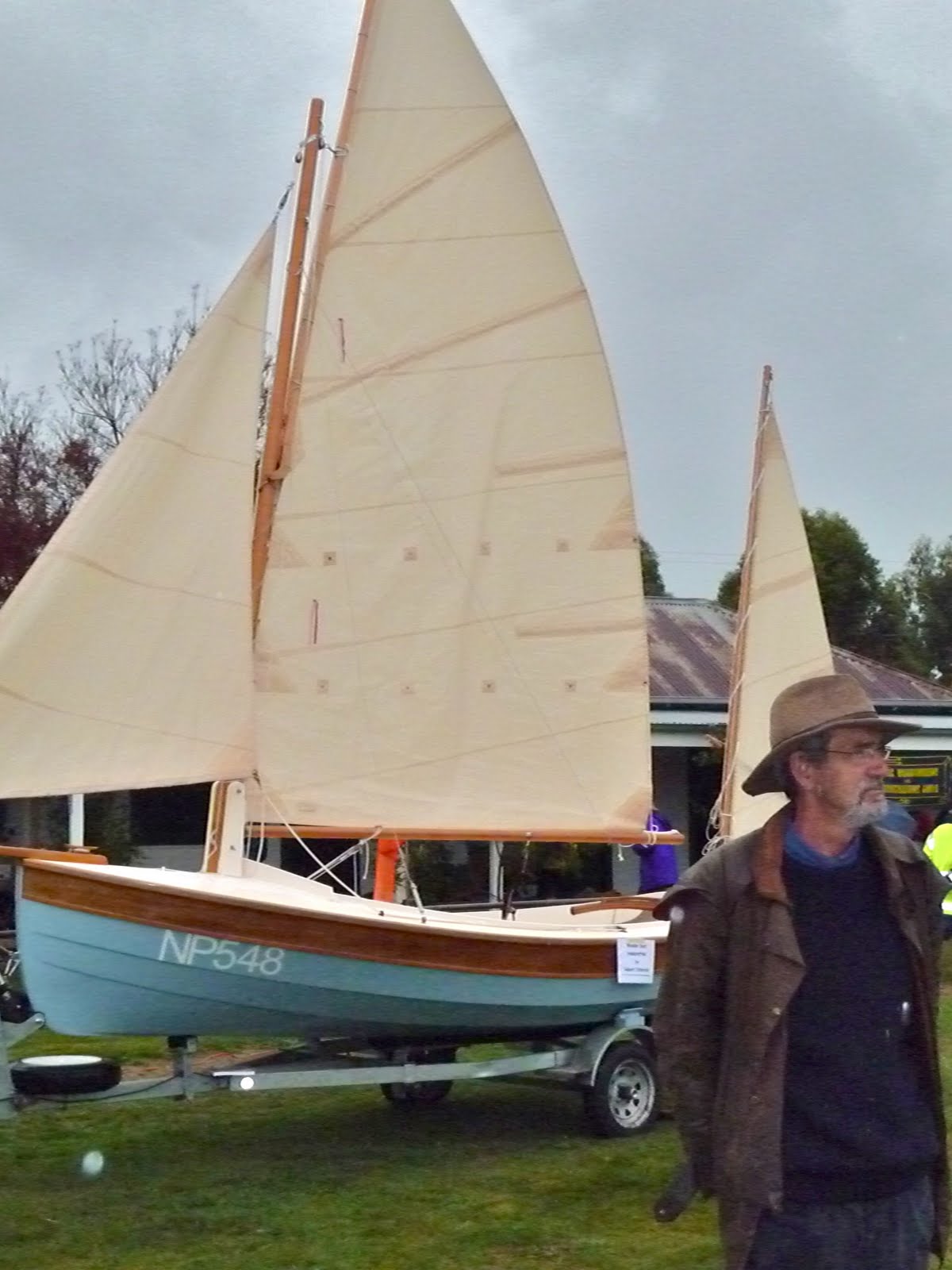 Sometimes a man learns from the most improbable things. The pic above is of Annie on display at our local community festival- an event normally about land-locked things, with an emphasis on local produce and skills. I was asked to display her by a desperate organiser, and I complied largely because I feel that I do so little for what is a wonderful country community with a real spirit.
 Bryan is the finest craftsman I've met and I'm proud to call him a friend. He began as a pattern-maker in his youth and the precision learnt then has informed all his work since, but it has been tempered by a keen relationship with the natural world- on and off the water, and a complex modern spirituality born of art and anchored in humility. This is just a little taste of some of the textures of his inner sanctum- a place where nothing is ever wasted and everything holds a possibility.


 In the picture above, an old Italian mandolin has begun its little transition from forgotten, neglected migrant artefact, to a playable addition to the self-imposed nudges at the edges of my comfort zone. I bought it for me, and I will enjoy the restoration, but in truth there are other members of my family much more likely to bring it into song. I think that I'm probably too lazy to make the tunes linger in the fingers long enough to out-pace my declining memory cells....The rosette has been re-fitted, and a couple of major belly cracks have been sorted so far. It was made in 1916- a tragic year- and it came to me in a homemade serge bag. I suspect it is made from 'great coat' fabric from the Italian army. I sometimes wonder what it might have seen and heard.

 Blessed with some benign and beautiful Autumnal weather, we have made good use of Corio Bay, it's space and its pleasant surrounds. There have been enough of the gusts to give me some grasp of the ability of this hull to get up and stir the soul, but gentle reminders of my limitations too. I've sailed one-up, two-up, and four-up (including a picnic of lovely things), and the boat has not behaved with any great difference on any occasion. It has a very adaptable and capable hull with enormous inherent stability. Because there is no cabin, the entire space is always available, so in some ways she really feels quite roomy even compared to our larger boat. That fine fellow stretching out in the photo above is over 6ft tall in the old measure, and while we sailed together he sat on every conceivable nook and cranny, and stood on a few as well, but we never lacked a place to stretch. And yet to launch this boat, or to tow her, is a whole margin easier than the 18 footer- and to rig her with that tabernacle is an absolute delight. To lift that swiveled main mast with one hand while the jib goes up consequently as an added bonus is a very real pleasure.


