Thursday, March 31, 2016

Paynesville 1905-ish. Fishing boats coming in


Despite this blog already being stretched across too many areas of content and interest, I can't resist these occasional delvings into the local history of boats- and working boats in particular.

The photo above is from Paynesville maybe 1905-ish, maybe earlier, but I still sail alongside boats that come from this era, and our boat was 30 odd years old when this pic was taken, and I can't help wanting to get inside this thing- whatever it is- that has persisted here for so long...and also to understand a little how it is that the local traditions are so unknown in the rest of the country.

I hope that any remaining readers will see how this picture differs so little from some of my recent postings. The persistence of these types even in small numbers is a celebration of the fact that the pioneers here took what worked from various immigrant traditions, and what worked then to earn a living is still a very suitable vehicle for exploring the lakes.

The four boats pictured are luggers. The one on the left is incredibly similar to Queen Mary, recently featured, the second one along has a canoe stern, and all four have those top strakes I mentioned in several recent posts.

These, of course were fishing boats. During this period there were already more lavish boats around here built on North American styles, to be used by the wealthy land owners for recreation. I will try to assemble some pictures of that type in another post. Our boat 'Beachcomber' was neither just a fishing boat nor only a recreational one.

It began it's working life as a transport and supply boat with picnic and social visiting benefits. During it's middle years though it was well known in the district as a sort of farm truck. I have spoken to a man locally who remembers Beachcomber fondly in the 1930's being 'sailed by Freddy Barton in all weathers', and he particularly remembers 'the boat full of sheep and also goats as Freddy transported his stock from island to island' near Sperm Whale Head. My informant tells me he lost contact with Beachcomber after 1946, and that was probably because she went to another family nearer Bairnsdale, probably until her restoration.


This line drawing is of the canoe stern type in the top picture. Both images were sourced from the Paynesville Maritime Museum.

Monday, March 28, 2016

The Gippsland Lakes 'Queen Mary' (again)


 In an earlier post I wrote about the characteristics that make this boat such a representative example of boats built in the local tradition. These pics illustrate the strake/carvel arrangement, but I include extra pics because she is just lovely.

Saturday, March 12, 2016

New sheets and Outhaul


Since the rally I have been moved to replace the main and staysail sheets, choosing 10mm over 12, and a multi-braid over 3 strand. The reason for this was that the cleats in a double-ended mainsheet need to work fast and they  struggled with the size and lumpiness of the old 3 strand.

Below are the main sail outhaul lashings and grommet- at the end of their working life. A new grommet was made for the job and a new outhaul line was spliced at both ends to attach to the 2 part adjuster, back along the boom. You may notice that in the old arrangement the grommet has been distorted by the lashings, so I fitted a galvanised eye into the outhaul line so the lashings will work on it and not the grommet. The outhaul pulls astern to a large sheave set in the boom, then back along the boom underside. The grommet stops the sail lifting, while the outhaul helps set sail shape.

Incidentally, we were thrilled by the shape of the sails, they are beautifully cut in a traditional pattern, with vertical seams on the main contrasting with the diagonals of the foresails.


Below the new grommet made from 8mm Hempex, next to the old pieces.


The other end has a wooden eye spliced onto it for the 2 part adjustment on the boom underside.


Thursday, March 10, 2016

Tuesday, March 8, 2016

it wasn't ALL about sailing but...


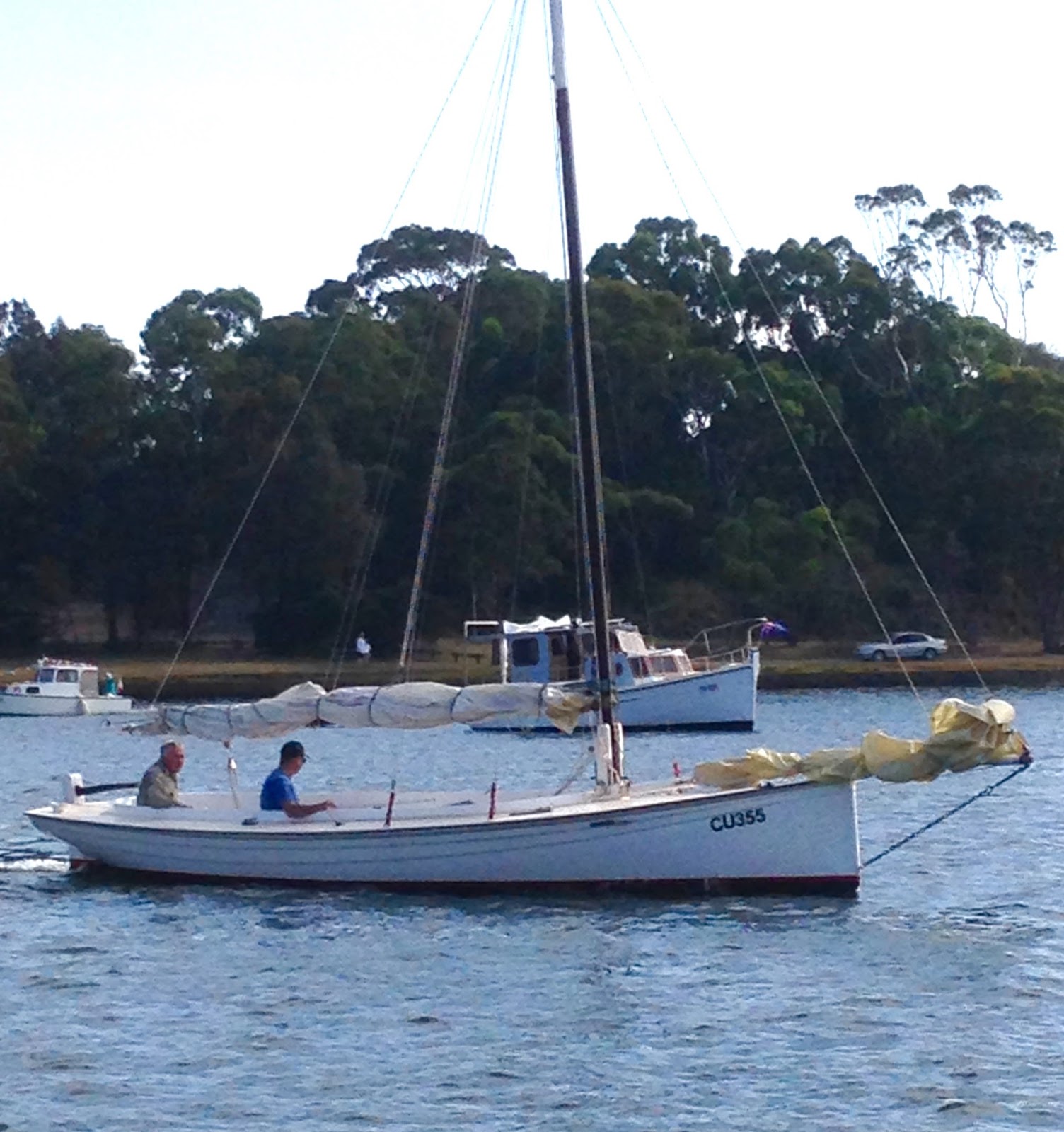
There was a lot more to the Rally than just sail boats, but whenever we got together, these old gaffers just seemed to meander around each other, like they were looking for family. Beachcomber and Queen Mary ( not the big one) above, sauntered back from the buoy in the non-race, finding the odd puff, but the trip back was made with cockpits alongside and conversation flowing between boats the whole way in.

QM has a feature which was common on Gippslander fishing boats. The hull is carvel up to the top two boards, which are lapstrake (clinker). The fishermen liked to approach the fish without the noise of strakes, but the top boards acted as spray rails. It is thought that this feature had it's origins in Norwegian boats and the idea came here with those people.

Owned by David Griffiths, she is 26ft by 9ft, with a 3'6" draft, and was built on Raymond Island (in the background of this pic) in 1898. Comparing her to Beachcomber (right) it can be seen that by the turn of the Century, the Gippslander type had evolved from British/European roots significantly. She is broad and shallow with a small transom and very capacious cockpit. If there is interest I can find more pics to illustrate the type. The above comparison is a bit dicey though, because one boat was always intended for carriage and cartage, while the other was designed specifically to fish.


Sunday, March 6, 2016

Paynesville Classic Boat Rally 2016


This was the first time I had ever sailed in such crowded and close quarters, and I was encouraged to join in the sail past (race) by our son Tristan (who gives me so much confidence at the helm). I record this sequence because the oldest boat in the fleet is here pictured moving past several boats in light winds, in a crowd. She is off-screen to the left, well and truly surrounded in the pic above. To be fair, quite a few then overtook us again when we rounded the point into the larger Lake Victoria, but Beachcomber definitely had a moment there....and so did we. She is not built for speed, but she gave us so much fun in several different sorts of conditions.


The rally was a huge success for the town of Paynesville and for the organiser, Peter Medling and his wonderfully helpful team. I will post more about the rally when the dust settles and I can feel my hands again. We made our way to the rally under sail on Friday (very light and lazy conditions) and made our way home upwind today, Sunday (3 hours) under the heaviest conditions that I'd encountered in this old boat. She was absolutely grand when pressed, and reassuring in the rough. I had the best crew imaginable and am so proud of his skills.

Please note that I have tried to make searching specific topics on this blog easier by providing a more limited number of topic labels in the right hand margin near the top. i.e. guitar making, harp making, sailing, Navigator etc.  Also a featured post from ones that seem to get constant attention. It will be changed from time to time.

Wednesday, February 24, 2016

Coasting; John Raban's book from the 1980's

Coasting: A Private VoyageCoasting: A Private Voyage by Jonathan Raban
My rating: 4 of 5 stars

Raban is not your average escapist writing about the bliss of being footloose in a boat. Where you might expect this simply to be a salty tale, it turns out being a wonderful insight into the state of Britain in the early 1980's, as glimpsed from the cockpit of his boat and his venturing into port as he makes his way around an island in a state of turbid change. He is an outsider in many ways but this is a very useful filter for his musings on the nature of a population surrounded by water, at a time when Thatcher was taking shots at the Argentinians over the Falkland Islands, and while the fishing and coal industries were taking seismic hits from which the labour force would never quite recover.

I really warmed to his prose and his insights, although he doesn't escape the inevitable difficulty of finding a suitable ending for a voyage which is pretty much circular.


View all my reviews

Sunday, February 21, 2016

Yet more Beachcomber pics


I still haven't found the time to replace the standing rigging, but the two foresails still pull us along nicely when the wind is on my back, making an incredibly economical motor trip even more so.


Apart from the shrouds, forestays and whiskers the bow sprit needs re-finishing too, and I promise to rid the boat soon of those ageing green sail covers. They were well made but have given up on any semblance of an organised appearance.


It turns out that our long motoring trips aren't much slower than those by friends with more powerful motors. A trip to 'The Barrier' near Lakes Entrance takes us about 50 minutes- a nice time for a lunch to be taken while we let some lovely wilderness pass us by. Those with tens of HP and planing hulls can do it in 20 minutes or so, but that is more commuting than travelling...The lid of the motor box serves as a handy and well-situated table.

Thursday, January 21, 2016

A 'Couta Boat on the lakes


Peter Medling of Paynesville came up with this picture of 'Pearl' built by Mitch Lacco in 1926 with a NZ Kauri hull and Queensland Beech decks. She was recently purchased and brought to the Lakes from Port Philip, I think...but I'll need to do a bit more digging for the details.

She is a powerful hull. Five up on the rails seem insubstantial. I am quite intimidated by the overhang of the boom!


I also include this pic from the early 20th Century of the jetty at Kalimna. The boat there is reputedly the one belonging to a well-known Melbourne business family, but it bears an uncanny resemblance to Beachcomber, whose origins and maker are still a bit obscure, despite lots of information.

 I recently spoke to a man whose lineage goes way back in this district and he claims that his ancestor was a likely builder of Beachcomber in the traditions of the French Canadian boats he learnt his trade upon before coming down to Oz. His name was MacMillan (a branch apparently unrelated to the explorer and pioneer in this area who has a very disturbing and unhappy reputation in his dealings with the local indigenous people ), and I'll be interested to find out more about him because the previous most likely builder has working dates that don't quite match Beachcomber's given history.

I keep an open mind on these things but glean anything I can by making these claims online and at dinners, and seeing what comes up...

Tuesday, January 12, 2016

Sooty the Noble Greyhound


This remarkable creature is new to the family, and while I'm more than happy to share my pleasure in having his companionship, the reason I'm including him here is somewhat more complex.

He is three and a half years old,  a former racing greyhound, and having survived four trainers and a short career- including his share of wins- he was taken to a vet to be euthanised, like thousands of similar dogs around the world, when they have 'served' what is seen to be 'their purpose'. 

This magnificent animal is such good company.  He is solid and uncomplicated and calm despite his great physicality. The reason he wasn't killed by the vet is that he was rescued by a local group who make it their business to find good homes for retired racing dogs, and many wonderful relationships have come from their efforts. Vets are often overcome by the wastefulness of these destructions and are happy to have an organisation to call. We offered to foster him for them until a 'forever home' could be found, but I became too attached to let him go without a struggle.

We have watched as he has become used to us, and we him. He is now rediscovering his playful puppy-self, and finding time to dwell a little on the joy of just being. It has taken a few weeks for us to understand his particular needs, his never having lived in a home before nor had the sort of affection that a pet might expect from people. These are a bit different from other dogs, but they are full of pleasant surprises. People expect them to need a huge amount of space and exercise, but they don't. People assume that they are dangerous because they are big and muscular, but they aren't. 

Some might assume that they are 'industrialised' and incapable of domestication, but they are intelligent and adaptable, and they are very quick to recognise a calm and happy environment and give out much more emotionally than they expect in return.

Everyone wants to pat Sooty when we walk him. He is a great ambassador for the breed. Currently he is helping us foster a frightened, timid little female  also rescued from a wasteful end. She has made very quick progress into some sort of confidence and will make someone an affectionate and loyal companion too, and our Sooty will have been a part of her initial re-education from an industry that seems unforgivably wasteful to me.

His racing name was Pod's Elect, and the video below is of one of his better races. 
A disclaimer. I have never been to the dog or horse races and I don't support the idea of racing animals. (But watch him come from behind. He is in the red jumper, no.1)


Friday, December 25, 2015

you say lapstrake, we say clinker


Our little clinker dinghy is finally back in the water, after months on blocks at the shed being attended to intermittently between house renovations and other duties. The antifouling is to allow her to stay in the water at the jetty- she is longer and heavier than most modern tenders.

Below, a new (old timber)Kauri breasthook and various grafts to replace rotten inwales made for a solid structure again, but over 80years of weathering meant that the strakes were never going to look really tidy without a total rebuild, and that was not my intention.


You can see she is not exactly a car-topper, but this arrangement did just fine for the short run to the creek.


It was a bit of a shock to find she tracked so straight and rowed so well, despite the cheap oars and rowlocks, and she has given us hours of simple pleasure already. In a previous post I may have mentioned her previous lives, including as the net transporter from fishing boat to the shore just over the creek from our house in the early parts of the 20th Century. I really love to have utilitarian objects that have their own stories.


Monday, November 30, 2015

Three Gippsland Gaffers


Three gaffers, each of quite different form on Gippsland lakes in the early Twentieth Century. Their names were The Wanderer (with a very shallow transom and a cutter style rig), The Flying Scud (with a transom that is shaped in a way more common in recent times and a simpler rig. She has lapstrake planking) and the Marjorie (with what appears to be a counter stern). Only the canoe stern type is missing from the mix.

It seems that the local builders adapted several 'old country' styles to the shallow waters of these lakes in the early more isolated times, but the later builds were then also influenced by the builders of Port Phillip when it became more common to bring boats into the area.

The typical 'couta boat' of the Melbourne/Geelong/Mornington/Bellarine areas evolved with heavier deeper keels to venture off-shore, while the Gippsland types that kept local traditions alive persisted with centre-boards to make unloading the catch easier on a beach. The counter stern became less common in time, but the canoe stern persisted along with the conventional transomed types and are still scattered amongst the berths and pens of the areas around Lakes Entrance, Metung and Paynesville.

Friday, September 25, 2015

Gippsland Lakes in the 1920's


This old promotional film of our area reeks of the inter-war period. I include it here because of the boats and fishing techniques,  but I'm also charmed by the style of the period.

Wednesday, September 23, 2015

To my lizard friends; I'm sorry


We are going to call him Keith after my father. I always regret becoming close to predators, because I know that the things they fancy and lust after as  menu items are also lovely small creatures that I like to spend time with. Some of my best friends may end up as his lunch.

Don't get me wrong. He's not called Keith because my dad was some kind of predator. That Keith was a giver, and a life-time solver of people's problems, but the thing that is pertinent here is that he was a morning whistler. One of those positive, enthusiastic souls for whom the morning was a cause for celebration and optimism. The sun had risen again, and that is enough to be happy. What a glorious thing it was to hear him whistle through his shower and shave, tunefully making his way back to the wardrobe in his short pyjamas. I fail both the whistling and the pyjama tests.

But the relationship between Keiths is even deeper. The one, pictured and I mimmick each other's call, and I'm almost certain that I can convince him to sing 'Some Enchanted Evening" eventually, but he keeps beginning in the wrong key. We are moving forward and the tunes are relentlessly positive in a 'King and I'  popular-musical-sort of way, like the things my dad used to whistle.

So Im naturally drawn to this bird, and he is causing me to whistle, and that causes me to remember my beautiful father, and that causes me to write this post.

So I continue to have confused and passionate relationships with predators and carnivors (like me) even though I believe that in a perfect world, we could all be fallen fruit and seed eaters....I just don't feel optimistic that I can convince this Keith about all the moral arguments that I would love to adopt if I were to become a better soul. But I'm working on his tunes. And he is connecting me with that bit of my father that was unfailingly optimistic despite his understanding of our limitations as humans.

I don't know if he ever understood that despite my turning away from many of the nineteenth Century religious paradigms that he held dearly, he was responsible for my on-going romantic idealism- that feeling that we can all do everything a little bit better if we give it some honest consideration.

Oh, and the bird? He is a grey butcher bird. Along with a clutch of King Parrots, Crimson Rosellas, Common Bronze-Wings, Magpies, Kookaburras, Rainbow Lorikeets, Pink Galahs, Wattlebirds, Honey-Eaters and Blue Fairy Wrens (amongst others) he is a beautiful part of the reason I'm enjoying being here, now.

Saturday, August 22, 2015

from horn cleats to a little bit of cam

 Beachcomber came with a splendid array of wooden horn cleats, and they somehow looked 'proper', and representative of the satisfying habit of 'making fast'. They are easy to use because they are big and well-proportioned, but for a sometimes lone, and a not overly confident self-taught sailor they presented a bit of a risk in a sudden gust if I need to de-power any or all of three sails quickly without leaving the helm. So I felt it was a safety issue to bring a little cam (calm?) into the arrangement.

The pic above shows the old horn and the new by-pass, through the combing to the cam cleat on a merbau block. The angle is 45 degrees. Being a two-ended main sheet, this end will be cleated off while I sit next to it, working its opposite number across and under the tiller- and that side can be cleated too, obviously...but released in a panic without needing to go anywhere.


I will arrange the jib sheet similarly, but I'm struggling to decide how far aft to take these cleats. If I had crew, they would prefer them further forward, near the side seats, but alone, I would prefer them quite close to the main sheet, so that two lines come from a similar direction can lay across my lap. Either way will have benefits...

The staysail is self-tacking and will probably remain horn cleated for the moment, because it its the outer one, the jib that is most likely to want to power me into trouble in a blow.