Showing posts with label Gippsland Lakes. Show all posts

Sunday, March 4, 2018

Paynesville Classic Boat Rally 2018 Day One


Paynesville Classic Boat Rally 2018 - Andrew Franks Photography from Andrew Franks on Vimeo.


The Paynesville Classic attracted more than 250 boats of many types and was attended by a huge, hungry and very appreciative crowd. We had static displays on the hard, exhibition tents, the Lady Nelson tall ship, fleets off classic cruisers steeped in local tourist history, and a wonderful fleet of Gippsland type fishing boats, many with multi-generational family histories here. Historic sailing craft, small dinghies, speed boats and work boats- a feast for the eyes. There was also a classic fishing boat race event and a scratch-build boat from plywood competition.

The video above does a great job of summarising (very quickly) the range of craft on display and in the water on the first day. This first day included a sail past by all water-borne entries. The grand parade of sail happened on the second day and I hope to have some good pics to share of that soon.

The event grew out of the very hard work by Peter Medling in the first instance. He has driven the now world-wide interest in the event through his energy and unfailing enthusiasm. It has been truly remarkable work. The huge team of volunteers were again outstanding in their cheer and helpfulness. As a participator with a long bowsprit we certainly relaxed in the comfort of knowing that managing a docking in a busy crowd would always be managed calmly and without fuss by one of the helpers who so magically appeared when needed. This warmth and cheer reflects so well on the local community.

Most of these pics have been freely shared on Facebook, and I include shots by various photographers with thanks.

even the dolphins joined in

the Tin Shed - a local floating institution provided a movable stage for music and commentary


Tuesday, January 23, 2018

before the regatta

A fishing boat crew before the Paynesville Regatta. Date unknown. Source; Paynesville Maritime Museum 

I include this as another example of the Gippsland type of boat in the early days of fishing our lake system. We can't date it but it appears to be late C19th. The main sail is lug and the rigging is typically simple and uncomplicated- no backstays or complicated block systems. The boat is probably 28ft or so, but easily beached. It appears that only the sax board or top strake is lapped. Often these early boats had 2 or 3 clinkers above the waterline. The thinking was to keep things smooth below the waterline to make less noise. I find the bowsprit interesting in that it is bending or possibly pointing downwards in a way that became a standard (although longer) on the big Couta boats  further west in Port Philip and Queenscliff.

Monday, May 8, 2017

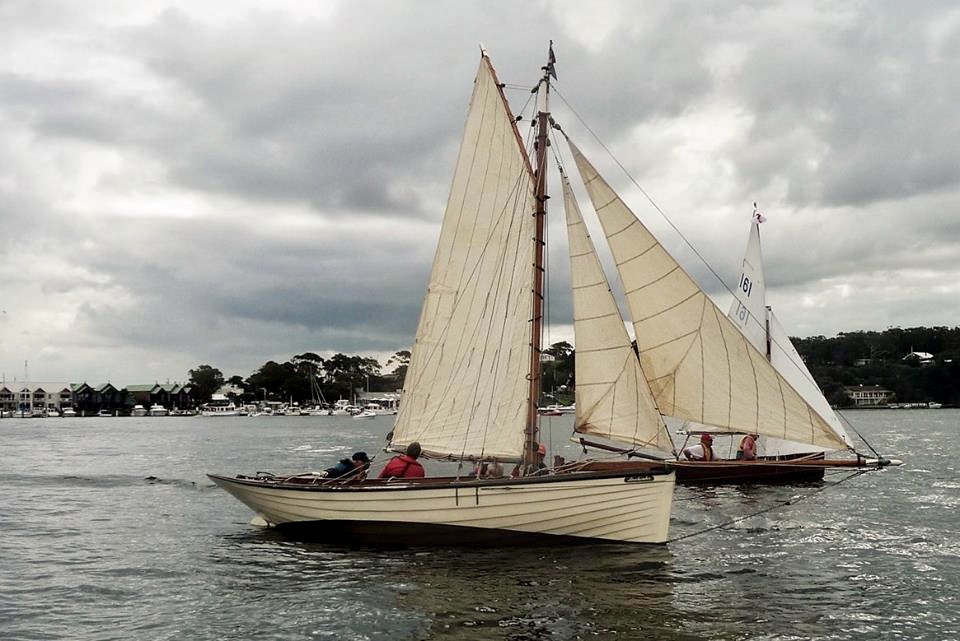
Metung old gaffers 2011


Chris Furey recently shared some old photos from one of the 2011 series of Metung Old gaffer races, and I thought I'd show them here, since Beachcomber was a participant. I feel a bit guilty that she hasn't competed recently, but her skipper nowadays struggles to find any interest in anything called a race, preferring less competitive pleasures. The guilt associated with this is  because the spectacle of the old timers jousting on the water is a spectator sport of merit....maybe one day I'll rediscover my adolescent competitiveness sufficiently to put aside my doubts about grown people trying to go faster than other grown-ups. For some reason I often overthink things that most people take as being perfectly reasonable.

Anyway there are some lovely boats here and you will see that the race was sailed in very light conditions. 


Monday, February 27, 2017

Tripping Up The Tambo


The last time I was this far up the Tambo I was driving a small outboard 'tinny', coaching a couple of senior rowing eights at a rowing camp in 1986. Above, this trip a group of us stopping for lunch. Bandicoot at the bottom of the picture. By the time we emerged  into Lake King for the trip home we faced into a strong head wind -right on the nose- and lines of persistent waves, but it was a comfortable 8 knots in the cab.


Boating with a motor is in no way as restful as sailing when the weather is fair. Even the little Yanmar on Beachcomber is quite calming as she potters along if she needs a push. But there are advantages to going a bit faster, having a bit of protection and a few facilities onboard and some real space to relax in. Most of all it is quite liberating to go home with fewer concerns about the weather.

Saturday, January 21, 2017

not a cabin in sight


This week end the Gippsland Lakes Classic Boat Club had a gathering of open boats at Paynesville, with a static display for the community on Saturday morning, followed by a sail past in the afternoon. Above are two local traditional types  above, the boat reported here during it's restoration (top), and the one in front was completed last year. What a splendid thing to have an old boat restored, and the old ways kept alive in a new boat; the two stories rafted up next to each other. These hulls have a real presence on the water.


Above, most of the boats have left for the sail past here, but I'm still chewing the fat in Annie. (Beachcomber stayed home for this one). I include this picture to show the local 'floating shed'- it appears to be at the end of the jetty, but it is in fact a mobile floating music stage and MC platform, a bit of an institution around here. It is powered by a 60hp outboard 'behind the shed'.


Thursday, March 31, 2016

Paynesville 1905-ish. Fishing boats coming in


Despite this blog already being stretched across too many areas of content and interest, I can't resist these occasional delvings into the local history of boats- and working boats in particular.

The photo above is from Paynesville maybe 1905-ish, maybe earlier, but I still sail alongside boats that come from this era, and our boat was 30 odd years old when this pic was taken, and I can't help wanting to get inside this thing- whatever it is- that has persisted here for so long...and also to understand a little how it is that the local traditions are so unknown in the rest of the country.

I hope that any remaining readers will see how this picture differs so little from some of my recent postings. The persistence of these types even in small numbers is a celebration of the fact that the pioneers here took what worked from various immigrant traditions, and what worked then to earn a living is still a very suitable vehicle for exploring the lakes.

The four boats pictured are luggers. The one on the left is incredibly similar to Queen Mary, recently featured, the second one along has a canoe stern, and all four have those top strakes I mentioned in several recent posts.

These, of course were fishing boats. During this period there were already more lavish boats around here built on North American styles, to be used by the wealthy land owners for recreation. I will try to assemble some pictures of that type in another post. Our boat 'Beachcomber' was neither just a fishing boat nor only a recreational one.

It began it's working life as a transport and supply boat with picnic and social visiting benefits. During it's middle years though it was well known in the district as a sort of farm truck. I have spoken to a man locally who remembers Beachcomber fondly in the 1930's being 'sailed by Freddy Barton in all weathers', and he particularly remembers 'the boat full of sheep and also goats as Freddy transported his stock from island to island' near Sperm Whale Head. My informant tells me he lost contact with Beachcomber after 1946, and that was probably because she went to another family nearer Bairnsdale, probably until her restoration.


This line drawing is of the canoe stern type in the top picture. Both images were sourced from the Paynesville Maritime Museum.

Monday, March 28, 2016

The Gippsland Lakes 'Queen Mary' (again)


 In an earlier post I wrote about the characteristics that make this boat such a representative example of boats built in the local tradition. These pics illustrate the strake/carvel arrangement, but I include extra pics because she is just lovely.

Thursday, January 21, 2016

A 'Couta Boat on the lakes


Peter Medling of Paynesville came up with this picture of 'Pearl' built by Mitch Lacco in 1926 with a NZ Kauri hull and Queensland Beech decks. She was recently purchased and brought to the Lakes from Port Philip, I think...but I'll need to do a bit more digging for the details.

She is a powerful hull. Five up on the rails seem insubstantial. I am quite intimidated by the overhang of the boom!


I also include this pic from the early 20th Century of the jetty at Kalimna. The boat there is reputedly the one belonging to a well-known Melbourne business family, but it bears an uncanny resemblance to Beachcomber, whose origins and maker are still a bit obscure, despite lots of information.

 I recently spoke to a man whose lineage goes way back in this district and he claims that his ancestor was a likely builder of Beachcomber in the traditions of the French Canadian boats he learnt his trade upon before coming down to Oz. His name was MacMillan (a branch apparently unrelated to the explorer and pioneer in this area who has a very disturbing and unhappy reputation in his dealings with the local indigenous people ), and I'll be interested to find out more about him because the previous most likely builder has working dates that don't quite match Beachcomber's given history.

I keep an open mind on these things but glean anything I can by making these claims online and at dinners, and seeing what comes up...

Monday, November 30, 2015

Three Gippsland Gaffers


Three gaffers, each of quite different form on Gippsland lakes in the early Twentieth Century. Their names were The Wanderer (with a very shallow transom and a cutter style rig), The Flying Scud (with a transom that is shaped in a way more common in recent times and a simpler rig. She has lapstrake planking) and the Marjorie (with what appears to be a counter stern). Only the canoe stern type is missing from the mix.

It seems that the local builders adapted several 'old country' styles to the shallow waters of these lakes in the early more isolated times, but the later builds were then also influenced by the builders of Port Phillip when it became more common to bring boats into the area.

The typical 'couta boat' of the Melbourne/Geelong/Mornington/Bellarine areas evolved with heavier deeper keels to venture off-shore, while the Gippsland types that kept local traditions alive persisted with centre-boards to make unloading the catch easier on a beach. The counter stern became less common in time, but the canoe stern persisted along with the conventional transomed types and are still scattered amongst the berths and pens of the areas around Lakes Entrance, Metung and Paynesville.

Friday, September 25, 2015

Gippsland Lakes in the 1920's


This old promotional film of our area reeks of the inter-war period. I include it here because of the boats and fishing techniques,  but I'm also charmed by the style of the period.