Showing posts with label making things. Show all posts

Friday, January 26, 2018

The trouble with perfection


One of the members of my workshop group was having the usual difficulties with some small and fine joinery, and her initial question was regarding the difficulties of accurate measurement, but the underlying issue was more searching.

She wanted to talk about the level of accuracy that she could be happy with, and she raised the issue of perfection. I had to start by saying that I don't embrace the search for perfection. I don't think that functional accuracy need be saddled with a striving for a flawless ideal, when inspired and energetic repetition is more likely to bring a quality that is much fresher, human and 'alive'.

We could spend ten years slaving to make a thing perfect or we could make dozens of things in the same period and in doing so we move our skills and our intuitive grasp of craft forward so much more. I'm not saying that big projects are a waste, because big projects are generally collections of little projects. Sometimes though, we need to look at the big goals rather than the problems which are in our faces. For me, making something is more about learning to make than it is about the product, at least if I'm to do more than simply manufacturing.


This attitude is hard to explain and I'm certainly not advocating shortcuts or shoddy workmanship. A really lovely piece of work will often appear easy, effortless and coherent.

If we start a piece thinking that it will only be good in the absence of mistakes we ignore the positive qualities that give rise to that beauty.

A curve, a shape or a cut can be a sweep of the hand that may reveal confidence and energy. This is what I aspire to, and the approach is intuitive rather than logical. And it takes lots of practice to make this kind of progress.

Someone in a hurry to achieve this would do well to use cheap materials as practice platforms for a specific skill, continuing to repeat the process until work can be done with less thinking and more feeling, more confidence and less anxiety about getting it right.

After all, this is precisely what musicians have to do to sound fluid and beautiful. The hands need to be taught how to act without conscious thought to a certain degree, through repetition. This frees the senses to concentrate on more specific perceptions.

Perfection is really akin to Plato's  pet concept in which he argues that our worldly existence can be likened to a shadow cast on the walls of a cave and seen by someone who has never been able to look at the real world outside. If they have only seen the shadows then the shadows seem real, so how can they possibly imagine the 'real' world? That person's shadows are our reality, and Plato wanted us to imagine the ideal world beyond our 'cave' walls. He would argue that everything and everyone has an ideal form and structure (and behaviour?) and we live and create to approach those ideals.

Despite what I've said about perfection for me as a goal in work, I do fit into the idealist mold with regard to life and design- I always feel we can do  things better if we are honest and thoughtful, and when designing something I'm always interested in finding the 'essential' forms and removing the complications that obscure them. Functional modernism is an expression of that.

The design for these small planes was very much a conscious attempt to  find an ideal form.


All of this thinking about idealism in design caused me to search out these old drawings from forty years ago in 1978. I wanted to make a methane digester to produce gas for cooking or powering a generator, particularly one that might be useful in agriculture to improve the compost value of animal waste, and to generate gas for domestic or farm use.

At the time there were interesting methane plants in India and China (hotter places, generally), but they were often messy and cumbersome designs that were labour intensive to build and use. That taste for the ideal caused me to try for a more rational design that might be manufactured in stackable modules.

Needless to say this idealistic boy in his 20's had neither the resources nor the money to do anything much with the idea, but I was fascinated with what we then called 'appropriate technology'. I noticed recently there is finally a company producing good manufactured small scale digesters- with the benefit of modern plastics, manufacturing methods and crowd funding. (I'm tempted to buy one)


From 1978, my design for a batch-fed, solar heated Methane digester, manufacturable in concrete. There are other sheets which compute inputs, outputs, volumes and carbon to nitrogen ratios.

thermo-syphoned solar heated water was integrated into the design to maintain an optimum digesting temperature in temperate or cool climates/seasons

On sloping sites the design allowed 'stacking', maintaining the optimum solar angle for that lattitude

I had a concrete company keen to manufacture a prototype, but I had no funds to develop the concept further.


Wednesday, October 11, 2017

plane scat


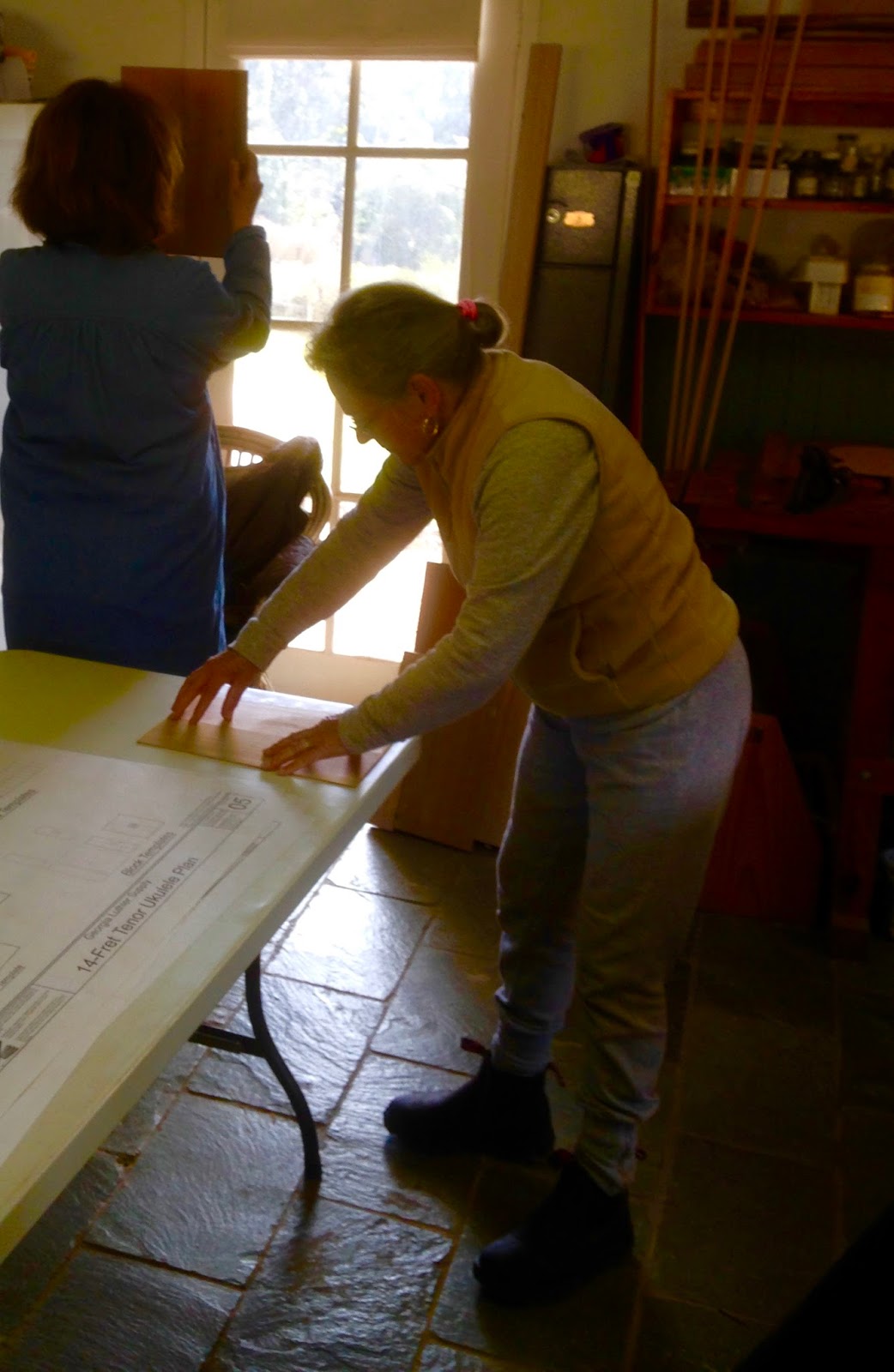
We have a little group that meets in my workshop once a week, and that group is part of a bigger group on Facebook, most of whom just want to see some real time work happening in pictures, and other posts about instrument making and tool use. (on Facebook; Metung Violin Maker's Workshop)
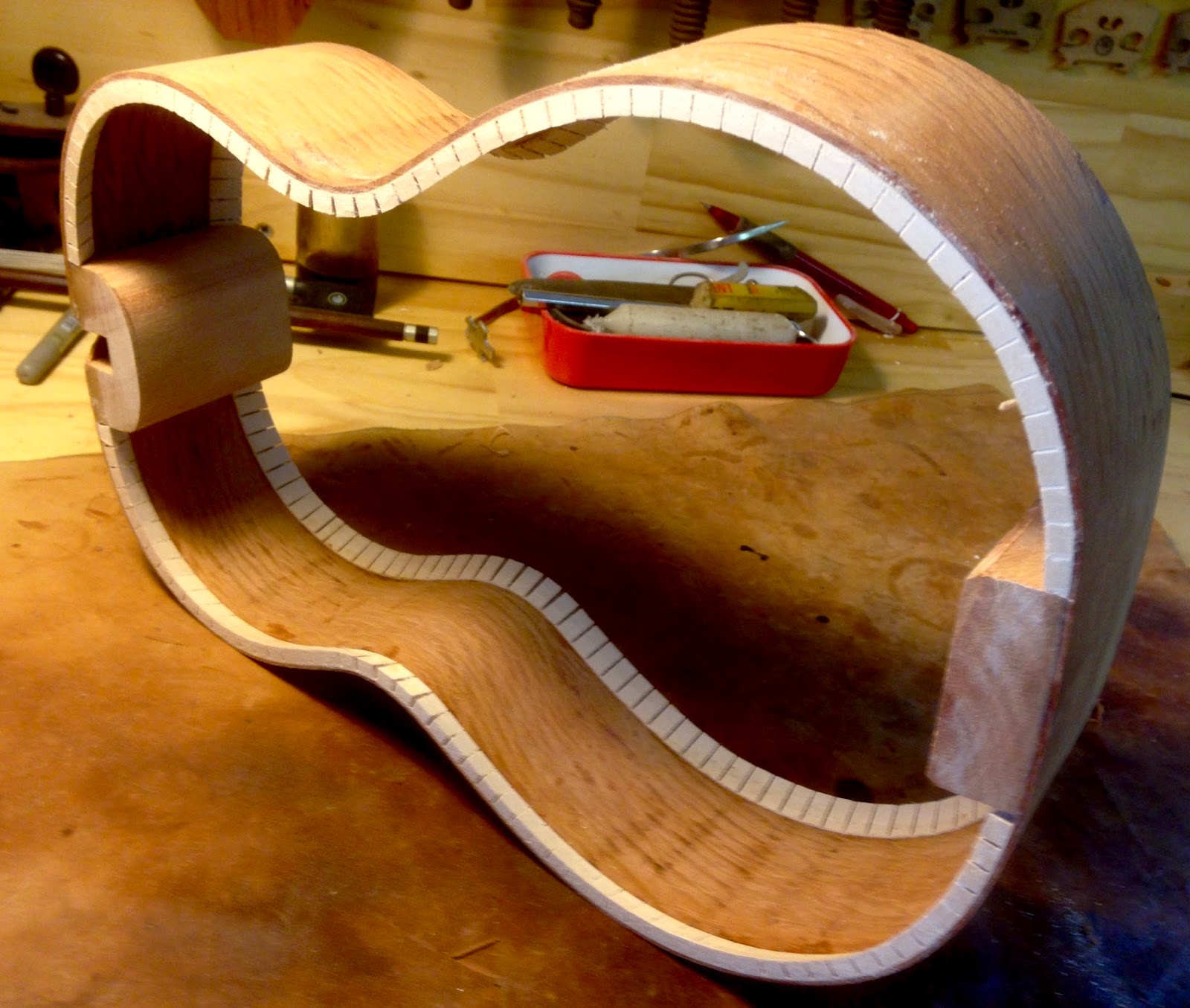
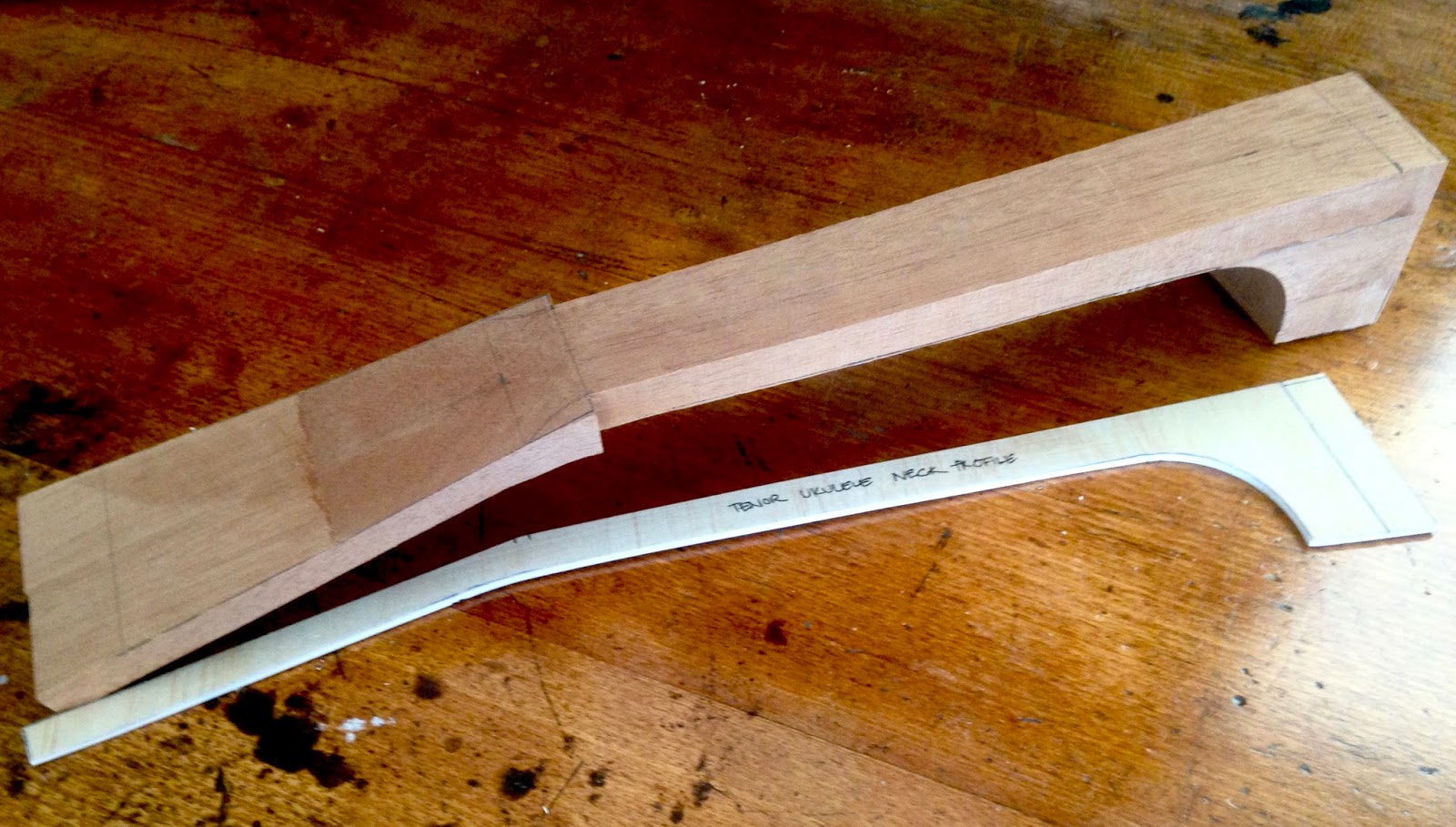
At the moment we have half a dozen tenor ukuleles being made. The uke has a lot in common with an acoustic guitar, without the acreage, and the option of fewer decorative details. But it is also a fantastic vehicle for learning some advanced tool skills including measuring, planing, carving, bending and tuning. At the end you have a very approachable, portable and social instrument.

This process is reason enough in and of itself, in answer to the question 'Why build a uke when you can buy one for twenty bucks?'


PLANE SCAT.
Why would you bother?
Let's put aside the obvious answers about sound quality and craftsmanship for the moment and look at these two pictures. The first is of Susan's pile of shavings and the second is of Daniels. They (like everyone in the group) both achieved several things today, but the 'plane scat' pictured here tells a really wonderful story if you know how to look at it.

Susan is planing slightly curly, hard and rather unforgiving blackwood and has used a plane which she was advised to use as if she was slicing tomatoes, rather than chopping them. So in practise, the plane is angled obliquely to the cut- or explained another way, the blade goes forward while the plane is angled at about 45 degrees to the side, and the ribbons produced are like DNA spirals. The grain is approached at an angle and the blade bites gradually.

She nailed it, and did so in quick time. Approaching wood with a cutting tool will be done differently for every piece, depending on grain, hardness, surface flaws and the size of the plane relative to the area that needs flattening.


Daniel's wood was a completely different proposition and he was able to flatten a great area and depth very quickly, confidently and energetically, taking thicker, front-on swathes from the softer, straighter-grained timber. His ribbons are like scrolls more than spirals.

The point is that to learn this kind of sensitivity to tools and materials is simply exquisite in my humble opinion; whatever the object is at the end, the interaction with these things is at the very heart of the connection between our eyes, ears, minds and hands- not to mention the connection to beautiful materials.

All of this could be done by machine, but none of these experiences can be replicated on a machine.


Saturday, September 2, 2017

in praise of drawing while thinking and learning


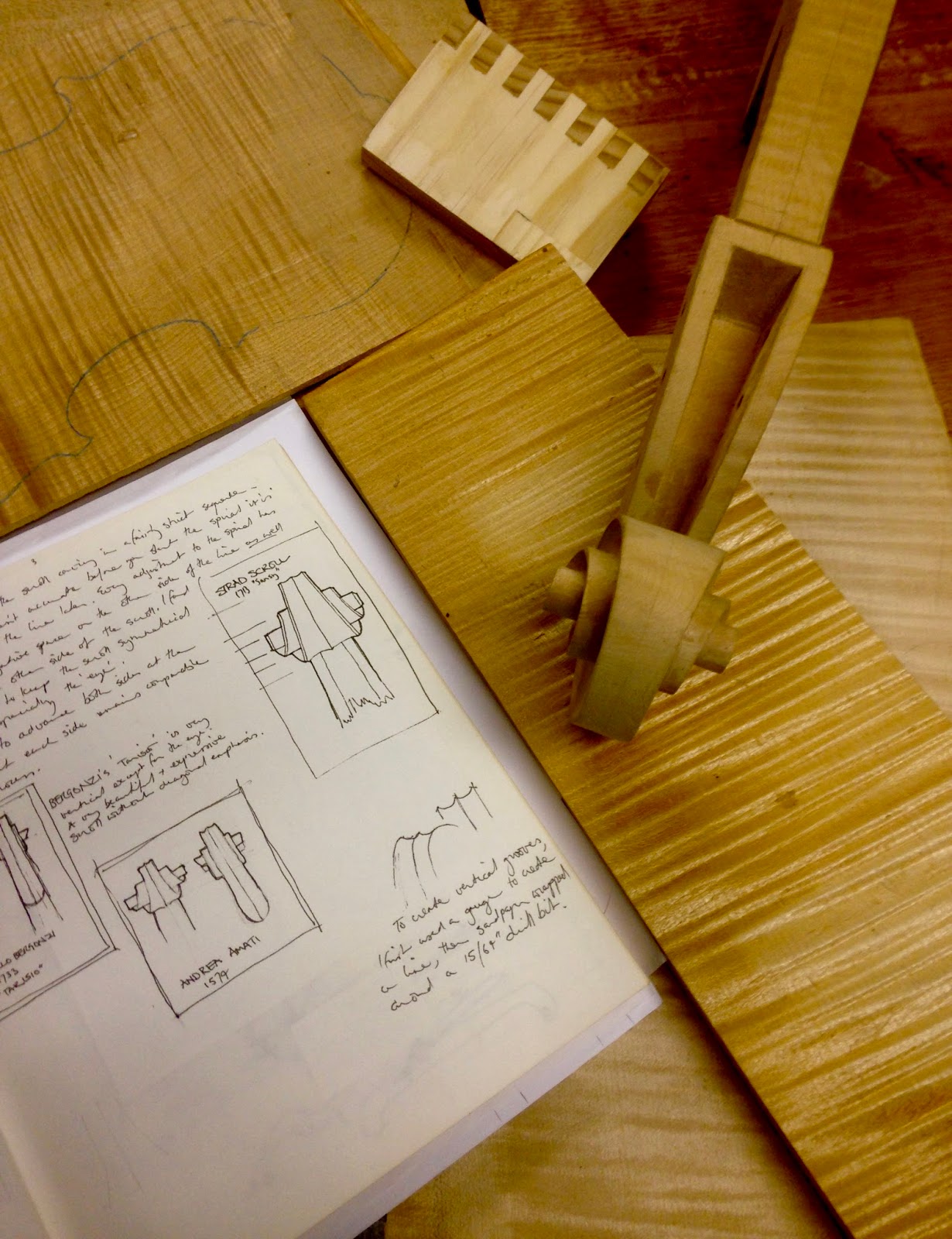
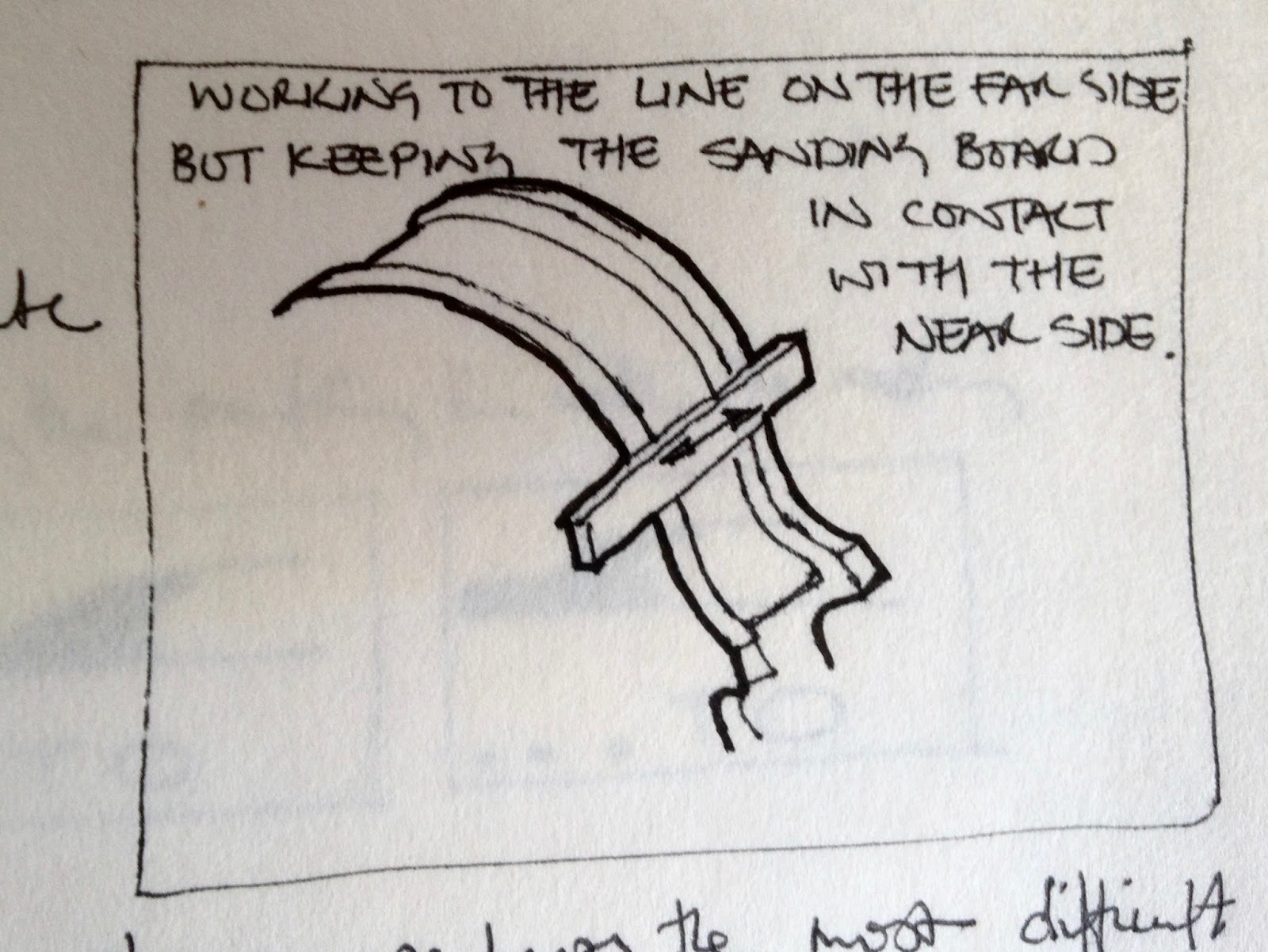
These sketches weren't drawn for anyone else, they were a personal 'external hard drive'  bound in a cardboard cover- the black book that pre-dates the black box. They were a part of my own visual journey to learn some new skills. They are rough and quick, but in giving emphasis to them with wobbly drawn frames and accented edges they became memories in themselves and the process of doing this reinforced little discoveries and helped me figure out priorities.


My visual diary or journal from learning to make instruments is pretty similar to the books I kept through art school and beyond. I think one of the reasons they became important to me was that learning something new or making a difficult thing really excited me, so the doing could be re-lived in the drawing, and this had the advantage of reinforcing creative experiences and helping me remember stuff- giving me reminders to come back to. Of course sometimes the drawings happen before the doing, and this enables visual testing of several solutions to little problems before taking up the tools. 'Several solutions' implies lateral thinking and that is a wonderful problem solving skill to adopt. There is always  a multitude of ways to do anything and the art is in finding the most elegant and the most fit for purpose.

Ideas in the head get out more easily if they can be tested through drawing. Making bad drawings is cheaper than making bad objects and failure at some level is what creation is all about. Over and over, we can always do better by simply doing more -thoughtfully.


This sort of drawing is not about pretty pictures, it is visual communication of a more technical and maybe personal kind. I'm so grateful for the training I had all those years ago in life drawing and technical drawing- the opportunity to spend repeated sessions over four years just connecting my mind with my hands through exploratory lines. These things became a habit and a joy.


I suppose something similar happens now to the penless generations with CAD and all the Apps, but I'm suspicious that something very direct between hand and eye will be lost if hands can no longer draw communicative or exploratory lines (or even ordinary ones) that make some sort of sense. But I guess that only applies to the small group of people who make things...


Monday, August 14, 2017

touchstone in a box


Back in the early 1980's I was very busy at work and it seemed like ages since I had made anything, so despite not having an adequate workspace to put things (or work) in, I built a bench and then this box. My Art Department was clearing out old storage and discarded some shelving but seeing that it was all Kauri Pine from pre-war times I lathered at the mouth a bit, and then saved the boards from a miserable, wasteful fate.

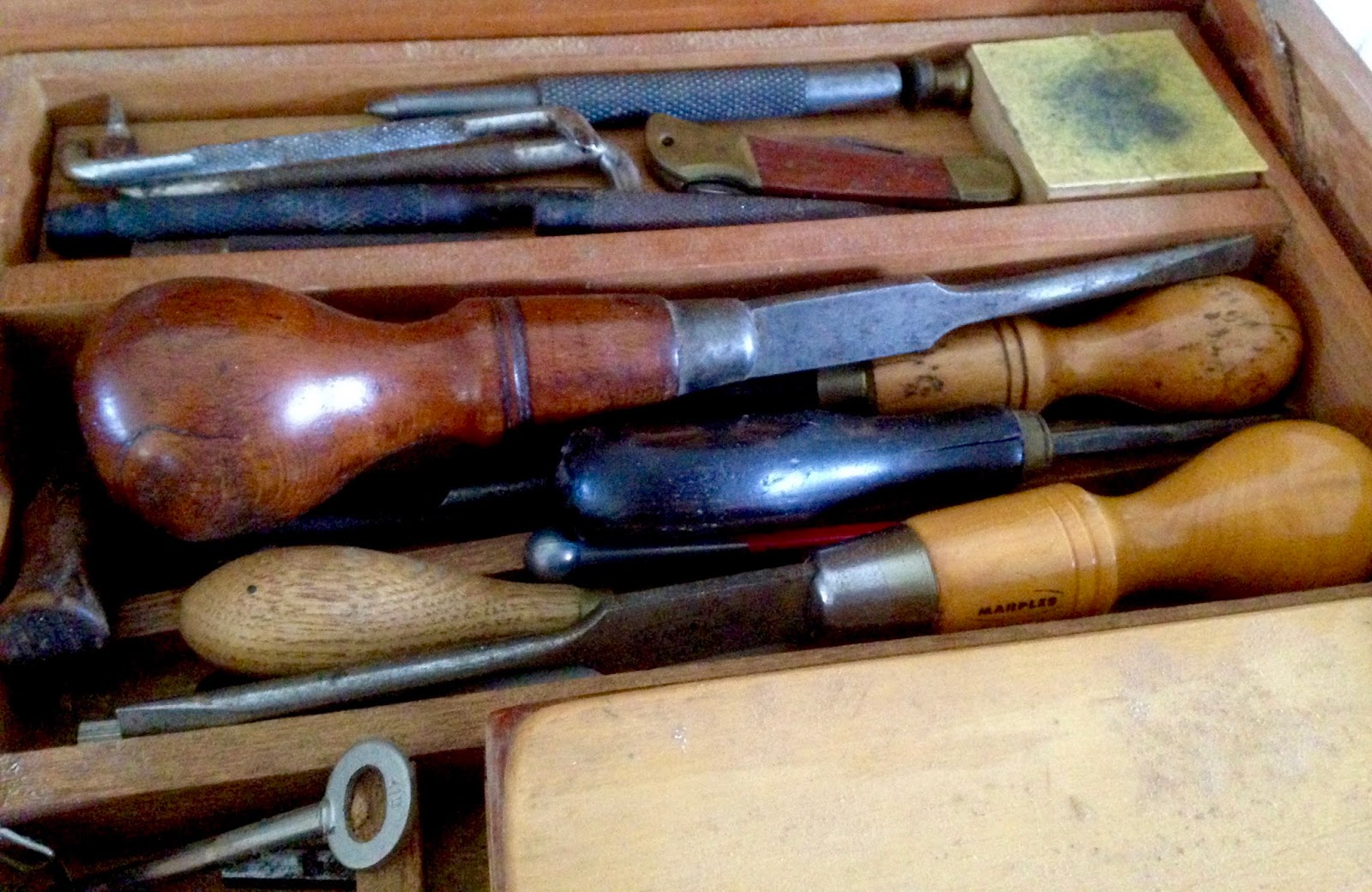
 It is several boxes within a box really, and nothing special in design or construction- but it has lasted a number of bumpy moves, and dark months in storage sheds covered in dust. I should have fitted handles but never got around to it. There is a box in there for my oil stone, but now that I use water stones it is there 'just in case'. The tray holding the old screw drivers can lift out or slide across. Those old drivers were my maternal grandmother's. She was the handy one in that household and her tools are over 100 years old now. I used to have quite a few of her old carving tools, but some were stolen when I set up shop as a violin maker, before they were even unpacked. The square in the lid belonged to my father. He was not very handy, but loved to potter and he did encourage me. He arranged for Santa to give me my first hammer when I was four and the coping saw in the lid of this box was a gift from him when I was in Grade Four at school. I still have the original box of blades that he gave me with it. Parts of the dovetails on various joints in these boxes were done using that coping saw.


When people brought me old family violins, wanting me to buy them I always tried to talk them out of it because inheriting an instrument or a tool that has been loved and used is to hold the possibility of creating something that furthers their memory I think. I generally bought the violin if they persisted but it was important to me to make the point anyway.


The bottom drawer lock has a lever which locks the lid too. What with the tools that I seem to have accumulated for different jobs over the years, this box has become a 'touchstone' for me, representing a time when I wanted to make things and to collect some treasures in one place. I still go to it, but the things I use most are now on the walls...and shelves...and drawers...and cupboards.


And finally, a few thoughts on boxes I shared for a group getting together to make some stuff with wood (from the Metung Violin Maker's Workshop Facebook Group).

For the people coming to our meet and greet who have limited experience with wood, may I suggest that you spend some moments thinking of a box that may be useful to you as a project to get started. It might be a tool box, a wooden tray for jewellery, an implement tote or caddy, a box for your boat, a box for rigging tools...etc. It might be rectangular, open, lidded, handled or plain. I'm thinking finger-jointed corners for machine experience or maybe hand cut dovetails for more experienced grafters with a determination to be patient. Boxes can be precious, utilitarian, humble or extraordinary. Maybe honest, vernacular and basic of pine, and machine made (but nicely), hand finished. Maybe delicate and decorated and hand cut from an exotic piece of wood that has a meaning for you..Putting meaning into simple things can be done through memory association, recycling old bits of a something that no longer works, maybe a shape that reminds you of a better time, or a special person, or maybe a function that reminds you of those things.
I'm just saying that in a group of more than four it may be that some need to consider an achievable goal that gets you into a 'groove' that makes getting ambitious and motivated more likely. We might then have secondary aims that are more ambitious and then I'll have time to prepare ideas, designs and materials. A beautiful piece of wood does not need to have a complex structure to invite people to touch, hold or admire it. I also recommend drawing ideas in a little sketch book if you can. Ideas in the head get out more easily if they can be tested through drawing. Making bad drawings is cheaper than making bad objects and failure at some level is what creation is all about. Over and over, we can always do better by simply doing more -thoughtfully.

Sunday, July 30, 2017

death after a thousand cuts


It's a sad day when a really useful tool gives up the ghost. This little Ryobi saw was one of the very first of the interchangeable battery models from that maker here in Oz, and over the years it cut the curved planks for two boat builds and two re-fits, innumerable cuts in house renovations, built-in furniture, decks and cladding. It was just getting to know it's second blade when I pushed it a little too hard. A little smoke delivered the bad news. I was to blame really because I had used it to cross cut 35mm hardwood boards for some bookcase tops in Julia's study and these small saws don't really appreciate thick hardwood especially late in life...

The thin kerf of this saw allows us to cut gentle (quite fair) curves in plywood with ease- so much more cleanly and steadily than a bandsaw or jig saw. Navigator Annie's planking needed very little edge clean-up between saw and paint; just a bit of time with a plane to level some irregularities.


I was worried that the replacement saw seemed bigger and bulkier, but the new design just feels more refined somehow and even better balanced with the battery on the side rather than behind the blade. The dust extraction port is also a great addition.


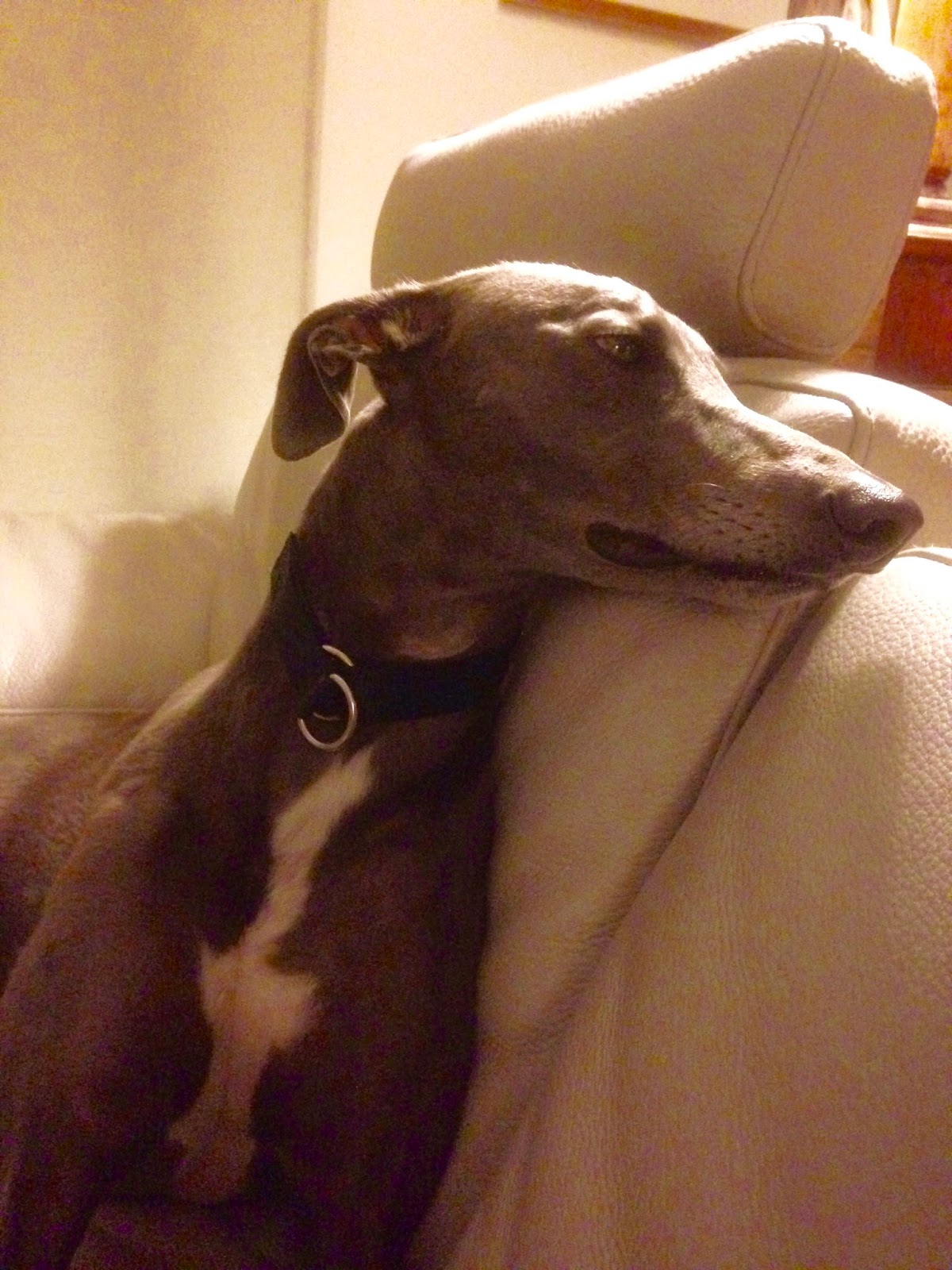
And I just include this picture of Ziggy looking philosophical because I find it comforting that even greyhounds struggle with the big existential questions.

Thursday, May 25, 2017

more on grown-up Meccano


What kind of shed would I need to have kept some of these old treasures? In my last post I referred to these two projects as being other examples of work I sometimes miss, sometimes think about. The first is a 1955 86 inch WB Series 1 Land Rover reborn in the mid 1970's, and the second is a 1970 88inch Series 2A, reborn in the mid 1990's. Hope someone finds them as sweet as I do.


Below, Series 2A Land Rover restored 1990's


Tuesday, May 23, 2017

On grown-up Meccano and Letting Go


Before we moved here we unceremoniously bade farewell to  Chrissy Shand, the Waller TS540 that I built some years ago. Moving to the other side of the state, with plenty to do- including the purchase of Beachcomber- we had to decide that her time had come, despite the great family fun that this boat enabled. I think it was a good decision, but I never made enough fuss about her when we sold, maybe because she was our first boat (and I'd already built another), maybe because with busy adult children those moments are harder to find, and maybe because I was always so intent on the next thing.


So here are a few pics to remind me of some of her progress. I always felt she looked better in the flesh, so to speak, than in photos. For a boat just shy of 18ft long though, she was remarkably roomy, particularly in the cockpit, and we often had five adults and a small dog happily scattered around her.


Chrissy Shand is one of several projects that I have done over the years that I miss from time to time. Most of the things that I've made for other people (mainly musical instruments) I tend not to miss, they were always made to be delivered and the benefit for me was learning all that I could in the process. It is the things I made that we used together that cause me to pause. For example there was a 1955 SWB Series 1 Land Rover I rebuilt and restored in the 1970's. Just gorgeous. A 1970 Series 2A Land Rover restoration in the 1990's, and various houses, buildings and bits of houses of course. I might collect a few pics of the old Land Rovers to keep as a record here too, one day. I've never been a 'petrol head', but I have always loved old Land Rovers (grown-up Meccano).


With three of us on sitting along the deck she was an awesomely powerful boat and an exhilarating ride.